
Looking for a fun way to practice math without getting stuck doing the same calculations over and over? These multiplication-riddles turn times tables, number patterns, and everyday situations into entertaining brain teasers for kids, students, teachers, parents, and adults who enjoy a mental challenge.
This collection includes easy multiplication puzzles for beginners, funny math riddles, missing-number challenges, real-life word problems, and tricky questions that require careful thinking. Every riddle has an answer, so you can check your calculations or hide the solutions to challenge a friend.
These puzzles can help learners practice multiplication facts, recognize equal groups, and understand how multiplication connects to division. They’re useful for classroom warm-ups, family game nights, math clubs, or a quick brain break during the day.
You don’t need advanced math skills to participate. Start with the simpler riddles, work your way toward the tougher challenges, and try to solve each puzzle before looking at its answer. Ready to put your multiplication skills to the test?
💡 Did You Know?
- Multiplication represents equal groups: For example, (4 \times 3) can mean four groups of three, giving a total of 12.
- Order doesn’t change the product: The commutative property means (6 \times 8) equals (8 \times 6).
- Division can check multiplication: If (7 \times 8 = 56), then (56 \div 7 = 8).
🎯 Riddle of the Day
- Four boxes sit beside the door,
Five little marbles fill each one in store.
Count every marble, then tell me true:
How many treasures are waiting for you?
Take a guess before revealing the answer!
Answer: 20 marbles — four boxes with five marbles each give (4 \times 5 = 20).
Easy Multiplication Riddles for Beginners
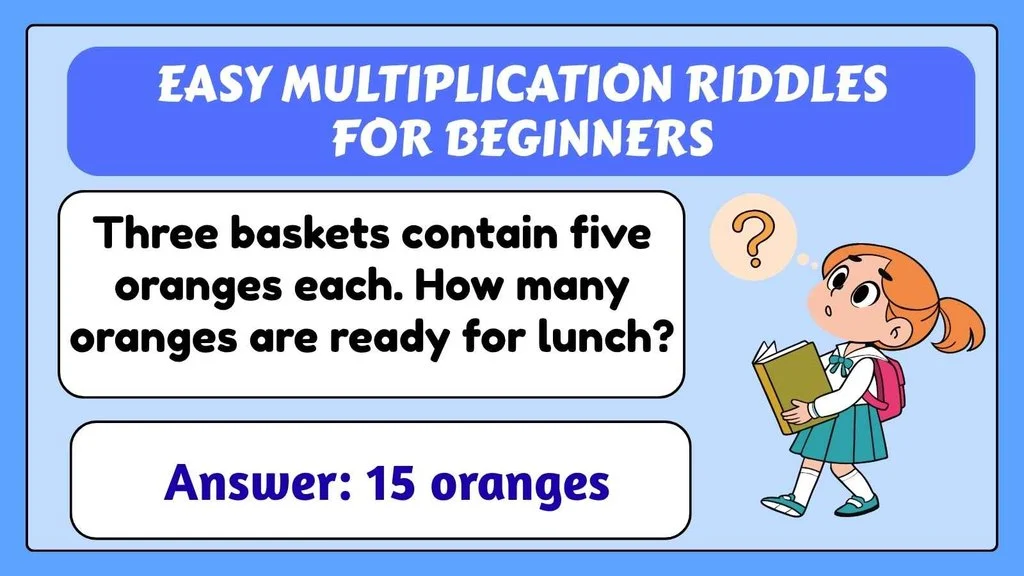
These simple puzzles use familiar objects and small numbers, making them suitable for children who are learning their first multiplication facts.
- Three baskets contain five oranges each. How many oranges are ready for lunch?Answer: 15 oranges — (3 \times 5 = 15).
- Six bicycles stand outside a store. Each has two wheels. How many wheels are there altogether?Answer: 12 wheels — (6 \times 2 = 12).
- Four friends collect three shiny stones each. How many stones do they collect?Answer: 12 stones — (4 \times 3 = 12).
- A baker places six cookies on each of two trays. How many cookies are cooling?Answer: 12 cookies — (2 \times 6 = 12).
- Seven birds sit on each of three fences. How many birds are perched there?Answer: 21 birds — (3 \times 7 = 21).
- Five children receive four stickers apiece. How many stickers are handed out?Answer: 20 stickers — (5 \times 4 = 20).
- Two shelves each hold nine books. How many books sit on both shelves?Answer: 18 books — (2 \times 9 = 18).
- Eight cups are placed on each of two tables. How many cups are ready for guests?Answer: 16 cups — (2 \times 8 = 16).
- A gardener plants four rows of six flowers. How many flowers brighten the garden?Answer: 24 flowers — (4 \times 6 = 24).
- Ten bags hold three marbles each. How many marbles are packed away?Answer: 30 marbles — (10 \times 3 = 30).
Funny Multiplication Riddles
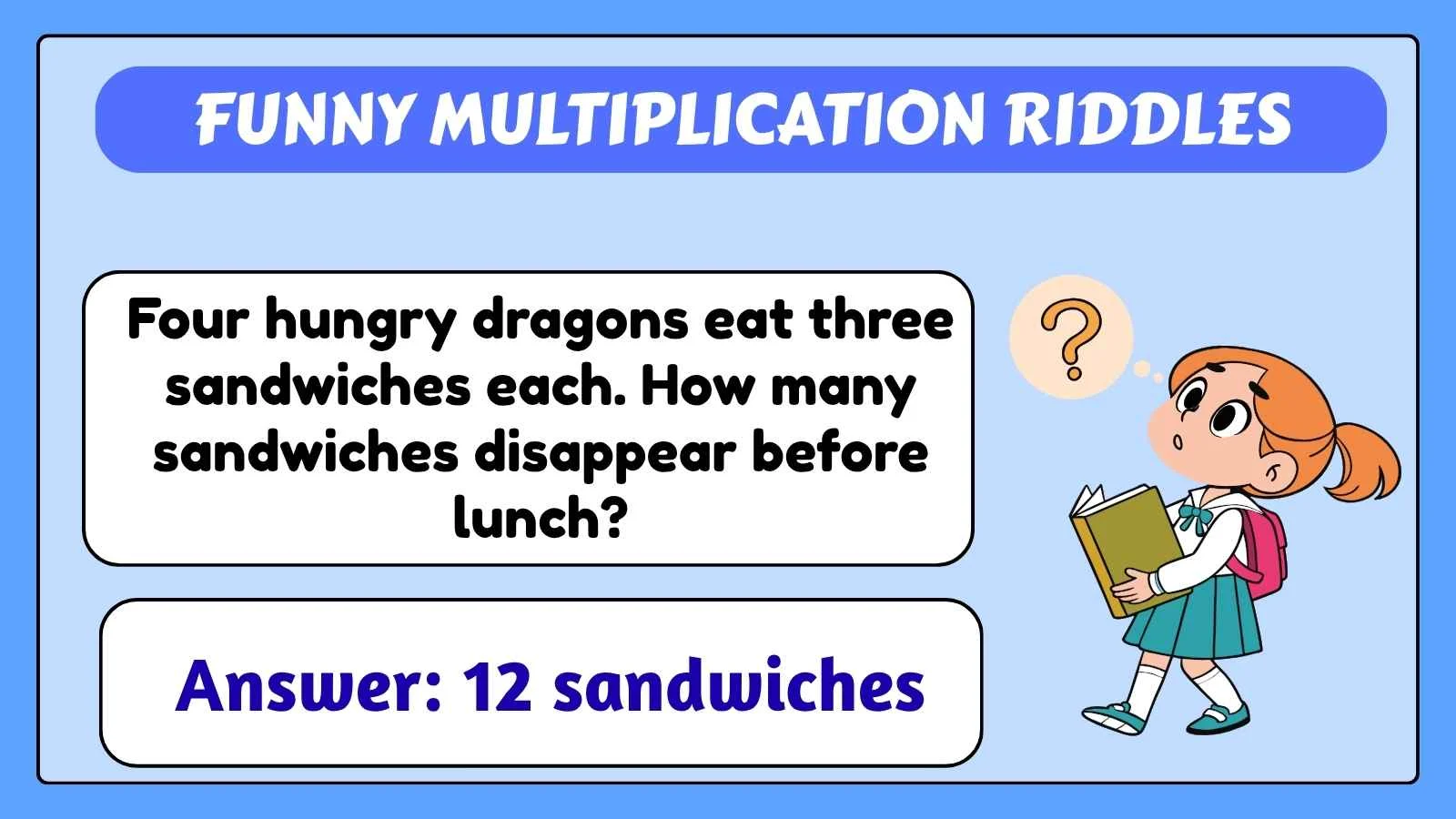
These silly math puzzles bring a little humor to multiplication practice. Share them with classmates or use them as entertaining brain breaks.
- Four hungry dragons eat three sandwiches each. How many sandwiches disappear before lunch?Answer: 12 sandwiches — (4 \times 3 = 12).
- Five aliens arrive for dinner, and each has four eyes. How many eyes stare at the pizza?Answer: 20 eyes — (5 \times 4 = 20).
- Three clowns carry seven squeaky toys each. How many squeaks can they produce if every toy is pressed once?Answer: 21 squeaks — (3 \times 7 = 21).
- Six penguins each wear a pair of socks. How many socks are on their feet?Answer: 12 socks — (6 \times 2 = 12).
- A robot tells eight jokes every hour. How many jokes does it tell in four hours?Answer: 32 jokes — (8 \times 4 = 32).
- Seven monkeys steal five bananas each. How many bananas have gone missing?Answer: 35 bananas — (7 \times 5 = 35).
- Two monsters have six mouths each, and every mouth wants one cookie. How many cookies do they need for one round?Answer: 12 cookies — (2 \times 6 = 12).
- Four chickens lay three eggs each. How many eggs are waiting for the breakfast chef?Answer: 12 eggs — (4 \times 3 = 12).
- Nine frogs wear two sunglasses each. How many individual sunglasses are needed?Answer: 18 sunglasses — (9 \times 2 = 18).
- A sleepy giant snores six times every hour. How many snores happen in five hours?Answer: 30 snores — (6 \times 5 = 30).
Times Table Multiplication Riddles
Practice familiar multiplication facts and strengthen your ability to recognize products quickly.
- Multiply seven by eight to find a number greater than fifty but less than sixty. What is it?Answer: 56 — (7 \times 8 = 56).
- Six times nine produces a number four greater than fifty. Find the product.Answer: 54 — (6 \times 9 = 54).
- Five groups of five make a square number. Which number completes the puzzle?Answer: 25 — (5 \times 5 = 25).
- Three dozen is the result of multiplying three by which number?Answer: 12 — (3 \times 12 = 36).
- Eight times four produces an even number between thirty and thirty-five. What is it?Answer: 32 — (8 \times 4 = 32).
- Eleven groups of seven produce a number with matching digits. What is the product?Answer: 77 — (11 \times 7 = 77).
- Twelve multiplied by twelve creates a three-digit square number. Name it.Answer: 144 — (12 \times 12 = 144).
- Nine pairs of shoes contain how many individual shoes?Answer: 18 shoes — (9 \times 2 = 18).
- Six times seven is six more than thirty-six. What number am I looking for?Answer: 42 — (6 \times 7 = 42).
- Ten groups of eight make a number ending in zero. What is the total?Answer: 80 — (10 \times 8 = 80).
Missing Number Multiplication Riddles
Find the hidden factor in each puzzle. These challenges also help you use division to reverse multiplication.
- Three times a mystery number equals 24. Which number belongs in the blank?Answer: 8 — (3 \times 8 = 24).
- A hidden factor multiplied by five produces 45. What is the missing number?Answer: 9 — (5 \times 9 = 45).
- Four equal groups contain 28 objects altogether. How many objects are in each group?Answer: 7 objects — (28 \div 4 = 7).
- Six multiplied by a mystery factor equals 72. Find the missing number.Answer: 12 — (6 \times 12 = 72).
- Double a hidden number and the result is 38. What number did you start with?Answer: 19 — (2 \times 19 = 38).
- Seven identical groups contain 63 objects altogether. How many objects are in each group?Answer: 9 objects — (63 \div 7 = 9).
- Eight times a mystery number gives 96. What is the missing factor?Answer: 12 — (8 \times 12 = 96).
- Nine equal groups contain 108 objects. How many objects belong in each group?Answer: 12 objects — (108 \div 9 = 12).
- Five multiplied by a hidden number equals 85. Can you uncover the factor?Answer: 17 — (5 \times 17 = 85).
- Twelve times an unknown number gives 144. What is the missing factor?Answer: 12 — (12 \times 12 = 144).
Everyday Multiplication Word Riddles
These real-life puzzles show how multiplication can solve everyday problems involving shopping, travel, school supplies, and more.
- A bakery packs eight muffins into each box. If it fills seven boxes, how many muffins are packed?Answer: 56 muffins — (8 \times 7 = 56).
- A bus has nine rows with four seats in each row. How many seats are available?Answer: 36 seats — (9 \times 4 = 36).
- Each notebook costs $4. What is the total price for six notebooks?Answer: $24 — (6 \times $4 = $24).
- A farmer plants eight trees in each of five rows. How many trees are planted?Answer: 40 trees — (8 \times 5 = 40).
- A movie theater has seven rows with ten seats per row. How many seats are in those rows?Answer: 70 seats — (7 \times 10 = 70).
- A delivery driver makes four trips and carries thirteen packages each time. How many packages are delivered?Answer: 52 packages — (4 \times 13 = 52).
- Three sports teams each have eleven players. How many players are there altogether?Answer: 33 players — (3 \times 11 = 33).
- A baker places nine eggs in each carton. How many eggs fit into eight full cartons?Answer: 72 eggs — (9 \times 8 = 72).
- A student reads for fifteen minutes each day over six days. How many minutes does the student read?Answer: 90 minutes — (15 \times 6 = 90).
- Twelve packets contain ten stickers each. How many stickers are there in total?Answer: 120 stickers — (12 \times 10 = 120).
Tricky Multiplication Brain Teasers
Read every clue carefully. These puzzles include extra steps and twists that reward attention to detail.
- A farmer has five pens with four sheep in each pen. How many sheep are there, not counting their legs?Answer: 20 sheep — (5 \times 4 = 20).
- Four boxes contain twelve pencils each. Three pencils are removed from every box. How many pencils remain?Answer: 36 pencils — each box has nine left, and (4 \times 9 = 36).
- Start with six, multiply by three, and then double the result. Where do you finish?Answer: 36 — (6 \times 3 \times 2 = 36).
- Five friends each buy three packs containing four cards apiece. How many cards do they buy altogether?Answer: 60 cards — (5 \times 3 \times 4 = 60).
- A store displays six shelves with seven toys on each shelf. It sells every toy on four shelves. How many toys remain?Answer: 14 toys — two shelves remain, and (2 \times 7 = 14).
- Eight children each own five marbles. One child gives away all five marbles. How many marbles remain with the other children?Answer: 35 marbles — seven children keep five each, so (7 \times 5 = 35).
- Three dozen eggs are divided equally among six cartons. How many eggs go into each carton?Answer: 6 eggs per carton — (36 \div 6 = 6).
- A floor has six rows of eight tiles. One entire row is covered by a rug. How many tiles remain uncovered?Answer: 40 tiles — five rows remain, and (5 \times 8 = 40).
- Four buses carry eighteen passengers each. Six passengers leave every bus at the next stop. How many passengers remain aboard?Answer: 48 passengers — each bus has twelve passengers left, and (4 \times 12 = 48).
- A student multiplies seven by eight and then subtracts seven. What is the final result?Answer: 49 — (7 \times 8 = 56), and (56-7=49).
Multiplication Patterns and Number Logic Riddles
Explore mathematical properties, square numbers, factor relationships, and patterns that make mental math easier.
- A number stays unchanged when multiplied by one but becomes zero when multiplied by zero. Which two multiplication properties explain this?Answer: The identity property and the zero property.
- Two squared is four, three squared is nine, and four squared is sixteen. What is five squared?Answer: 25 — (5 \times 5 = 25).
- Two consecutive whole numbers, six and seven, are multiplied together. What product do they make?Answer: 42 — (6 \times 7 = 42).
- Multiply a positive whole number by ten. Which digit will appear at the end of the product?Answer: 0 — for example, (8 \times 10 = 80).
- The factors four and nine switch places. Does their product change, and what is it?Answer: No; the product remains 36. Both (4 \times 9) and (9 \times 4) equal 36.
- Start with four, double it, and double the answer once more. What number appears?Answer: 16 — (4 \times 2 \times 2 = 16).
- Two equal positive whole-number factors multiply to make 64. What is each factor?Answer: 8 — (8 \times 8 = 64).
- Multiply a number by three to get 24, then add the original number to the product. What is the total?Answer: 32 — the original number is 8, and (24+8=32).
- The product is 72, one factor is eight, and the other is a whole number. Find the missing factor.Answer: 9 — (8 \times 9 = 72).
- Find a number greater than 20 and less than 30 that is divisible by both four and six.Answer: 24 — (4 \times 6 = 24).
Advanced Multiplication Riddles
These harder puzzles are designed for learners who know their basic multiplication facts and want to practice multistep calculations.
- Multiply sixteen by five, then subtract fifteen. What remains?Answer: 65 — (16 \times 5 = 80), and (80-15=65).
- Three identical positive whole numbers multiply to make 343. What is each number?Answer: 7 — (7 \times 7 \times 7 = 343).
- A warehouse stores fifteen cartons in each row. There are eleven rows, but three full rows are removed. How many cartons remain?Answer: 120 cartons — eight rows remain, and (8 \times 15 = 120).
- Multiply forty-eight by twenty-five using a helpful number pattern. What is the product?Answer: 1,200 — (48 \times 25 = 12 \times 100 = 1{,}200).
- A number multiplied by nine equals 162. What would you get by multiplying that original number by four?Answer: 72 — the original number is 18, and (18 \times 4 = 72).
- Six machines each make thirty-five parts per hour. How many parts do they produce in four hours at the same rate?Answer: 840 parts — (6 \times 35 \times 4 = 840).
- Multiply thirty-two by twenty-five. Use the fact that four groups of twenty-five equal one hundred. What is the answer?Answer: 800 — (32 \times 25 = 8 \times 100 = 800).
- A school buys seventeen boxes of markers, with twenty-four markers in each box. How many markers does it purchase?Answer: 408 markers — (17 \times 24 = 408).
- Two positive whole numbers multiply to make 98. One factor is twice the other. What are the factors?Answer: 7 and 14 — (7 \times 14 = 98).
- A rectangular garden measures fourteen feet long and nine feet wide. Each square foot needs three decorative stones. How many stones are required?Answer: 378 stones — (14 \times 9 = 126) square feet, and (126 \times 3 = 378).
Multiplication Riddles for Classroom Games
Teachers can use these puzzles for warm-ups, partner activities, math stations, and quick multiplication practice.
- Nine students each receive seven counters. How many counters does the teacher distribute?Answer: 63 counters — (9 \times 7 = 63).
- Five teams earn eight points each in a classroom contest. What is their combined score?Answer: 40 points — (5 \times 8 = 40).
- A teacher places eleven worksheets on each of four desks. How many worksheets are distributed?Answer: 44 worksheets — (11 \times 4 = 44).
- Fourteen students each solve three bonus problems. How many problems are solved in total?Answer: 42 problems — (14 \times 3 = 42).
- Seven pairs of students receive six colored pencils per pair. How many pencils are handed out?Answer: 42 pencils — (7 \times 6 = 42).
- A class decorates eight posters with nine paper stars each. How many stars are needed?Answer: 72 stars — (8 \times 9 = 72).
- Six students each earn fifteen points during a game. What is their total score?Answer: 90 points — (6 \times 15 = 90).
- A teacher shares seventy-two counters equally among nine groups. How many counters does each group receive?Answer: 8 counters — (72 \div 9 = 8).
- Eleven classmates each bring two books for a reading corner. How many books arrive?Answer: 22 books — (11 \times 2 = 22).
- A math contest includes five rounds, with seven questions per round. How many questions are there altogether?Answer: 35 questions — (5 \times 7 = 35).
Multiplication Riddles for Family and Friends
Challenge your family or friends with everyday math puzzles. Take turns reading a clue and explaining how you found the answer.
- Four families each bring three pies to a neighborhood gathering. How many pies arrive?Answer: 12 pies — (4 \times 3 = 12).
- A photo album has nine pages with six photos on every page. How many photos fit in the album?Answer: 54 photos — (9 \times 6 = 54).
- Eight friends each save seven dollars for a group activity. How much do they save together?Answer: $56 — (8 \times $7 = $56).
- Five siblings each plant eight seeds in the garden. How many seeds are planted?Answer: 40 seeds — (5 \times 8 = 40).
- A family buys four packs of twelve juice boxes for a picnic. How many juice boxes do they have?Answer: 48 juice boxes — (4 \times 12 = 48).
- Seven guests each bring two gifts to a celebration. How many gifts arrive?Answer: 14 gifts — (7 \times 2 = 14).
- Six cousins each take nine pictures during a trip. How many pictures do they take?Answer: 54 pictures — (6 \times 9 = 54).
- A card game begins with four players, each receiving thirteen cards. How many cards are dealt?Answer: 52 cards — (4 \times 13 = 52).
- Nine relatives each bring four desserts to a reunion. How many desserts are brought?Answer: 36 desserts — (9 \times 4 = 36).
- Three friends each solve eighteen multiplication problems. How many problems do they solve altogether?Answer: 54 problems — (3 \times 18 = 54).
Tips for Solving Multiplication Riddles
A few simple habits can make these puzzles easier and more enjoyable.
- Look for equal groups: When objects are arranged in identical groups, multiplication is often the quickest way to count them.
- Break large numbers apart: For example, (12 \times 6) can be calculated as ((10 \times 6)+(2 \times 6)=72).
- Use familiar facts: If you know (5 \times 8=40), you can use that result to work out (6 \times 8=48).
- Check with division: If you calculate (9 \times 7=63), confirm it with (63 \div 9=7).
- Read the wording carefully: Check whether the question asks for groups, individual objects, a remaining amount, or a total after several steps.
- Explain your reasoning: Saying how you reached an answer can help you spot mistakes and strengthen understanding.
- Make it a game: Hide the answers, set a friendly time limit, or award points for correct explanations.
- Write your own riddles: Choose a familiar topic, such as pets or sports, and build a multiplication question around equal groups.
FAQs:
What are multiplication riddles?
Multiplication riddles are math puzzles that use clues, patterns, or everyday situations to help solvers calculate products or discover missing factors.
Are multiplication riddles good for kids?
Yes, age-appropriate multiplication riddles give children a playful way to practice times tables, develop number sense, and explain their reasoning.
How can I make multiplication riddles easier?
Start with small numbers, use familiar objects or drawings, and gradually introduce larger factors as confidence grows.
Can teachers use multiplication riddles in class?
Yes, teachers can use them as warm-ups, partner challenges, math-center activities, exit tickets, or friendly team competitions.
What is the difference between multiplication riddles and word problems?
Word problems usually focus on calculating an answer from a described situation, while riddles often add a twist, pattern, or hidden clue.
How can I improve at solving multiplication riddles?
Practice your times tables, break larger calculations into smaller steps, read clues carefully, and use division to check your answers.
Conclusion:
These multiplication-riddles make math practice more engaging, whether you’re learning basic times tables, teaching a classroom, or challenging friends with harder brain teasers. From funny scenarios and missing-number puzzles to everyday calculations and advanced number logic, this collection offers challenges for a range of skill levels. Take your time, explain how you reached each answer, and treat mistakes as opportunities to learn. With regular practice, multiplication facts can become easier to recognize and apply. Which riddle did you solve fastest? Share your favorite with a friend or challenge a classmate to see who can solve the most!
