
Learning English becomes more enjoyable when you turn vocabulary practice into a game. ESL riddles help English learners build vocabulary, understand sentence structure, practice reading comprehension, and think creatively while solving fun puzzles. Whether you are a beginner learning everyday words or an advanced student looking for a challenge, riddles offer an engaging way to use English beyond traditional exercises.
This collection includes easy riddles for beginners, funny puzzles for classroom activities, vocabulary challenges, grammar-based questions, and brain teasers for advanced learners. Each riddle comes with a clearly labeled answer, making it easy for students to check their understanding and learn unfamiliar words.
Teachers can use these English riddles as warm-up activities, speaking exercises, homework, or group competitions. Students can also practice independently, challenge classmates, or use the clues to develop their listening and reasoning skills.
Read each riddle carefully, look for important clues, and try to answer in English before checking the solution. You might discover that learning a language can be just as entertaining as solving a mystery!
💡 Did You Know?
- Context helps readers understand words: The words around an unfamiliar term can provide clues to its meaning.
- Riddles combine language and reasoning: Solving a riddle often requires understanding clues, considering different meanings, and drawing a conclusion.
- Speaking practice can be interactive: Pair activities, question-and-answer games, and group discussions give English learners opportunities to use language in meaningful situations.
🎯 ESL Riddle of the Day
I have pages but cannot speak,
I share new words with those who seek.
Open me up and you may find
A world of stories for your mind.
What am I?
Try to guess before you reveal the answer!
Answer: A book.
🟢 Easy ESL Riddles for Beginners
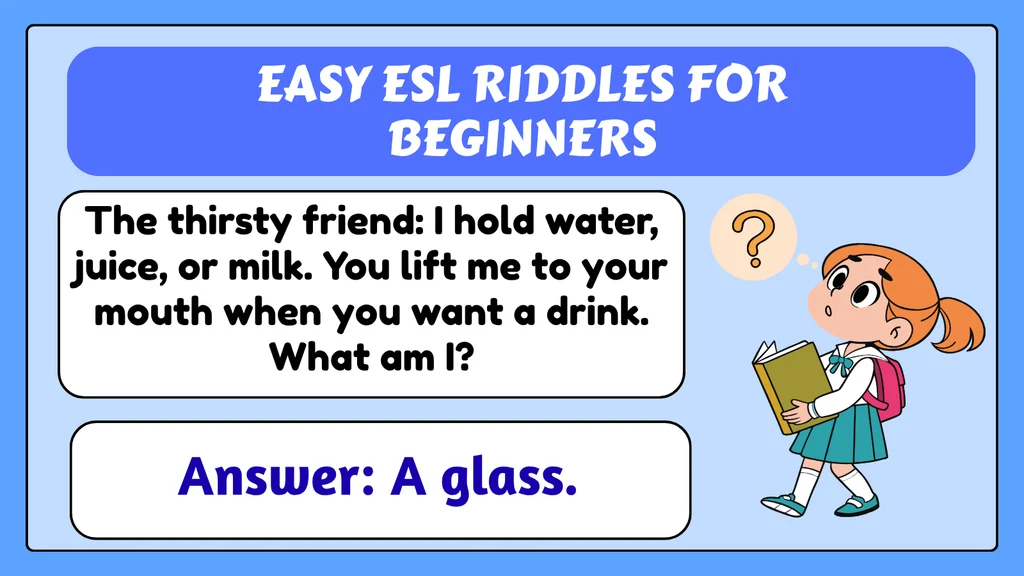
These simple English riddles use familiar objects and everyday vocabulary. They are ideal for A1–A2 learners, young students, and anyone building confidence in English.
- The morning helper: I wake you up with a loud sound, but I am not a person. You may keep me beside your bed. What am I?Answer: An alarm clock.
- The thirsty friend: I hold water, juice, or milk. You lift me to your mouth when you want a drink. What am I?Answer: A glass.
- The rainy-day companion: I open above your head when rain begins and fold when the sky becomes clear. What am I?Answer: An umbrella.
- The writing tool: I leave dark marks on paper, and you can remove many of them with an eraser. What am I?Answer: A pencil.
- The cold keeper: I live in the kitchen and keep food fresh by staying cool inside. What am I?Answer: A refrigerator.
- The nighttime light: I shine in the sky after sunset and can look round or like a thin curve. What am I?Answer: The moon.
- The four-legged pet: I may bark, wag my tail, and enjoy playing fetch. What animal am I?Answer: A dog.
- The room visitor: I let sunlight and fresh air enter a room when you open me. What am I?Answer: A window.
- The foot protector: You usually wear me outside to protect your feet while walking. What am I?Answer: A shoe.
- The sweet birthday guest: I may have candles on top, and people often eat me during birthday celebrations. What am I?Answer: A birthday cake.
😂 Funny ESL Riddles to Make Learning Enjoyable
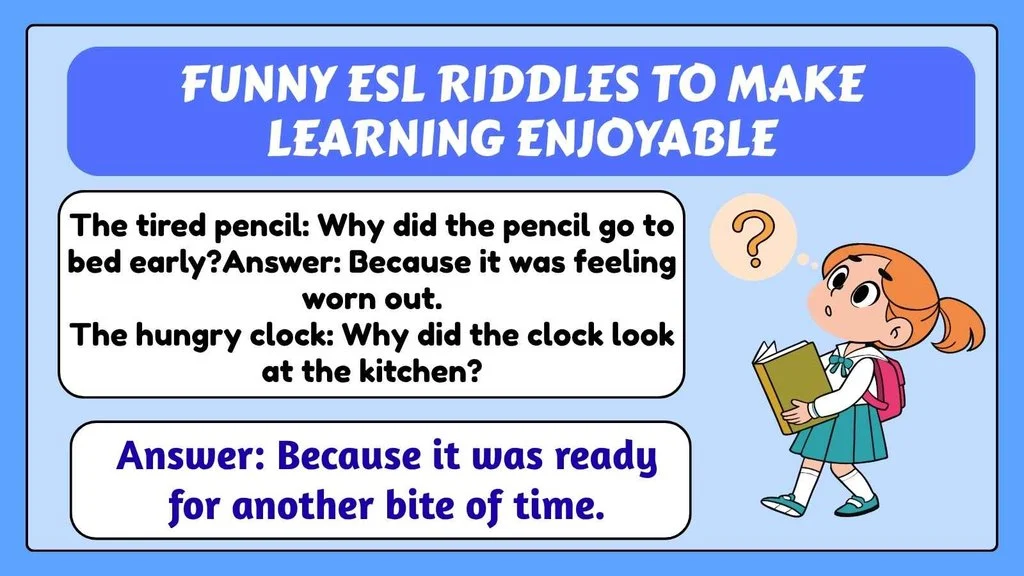
These lighthearted riddles help students practice simple questions, understand everyday situations, and enjoy English wordplay.
- The tired pencil: Why did the pencil go to bed early?Answer: Because it was feeling worn out.
- The hungry clock: Why did the clock look at the kitchen?Answer: Because it was ready for another bite of time.
- The shy tomato: Why did the tomato hide behind the vegetables?Answer: Because it did not want to be seen blushing red.
- The talkative book: Why did the book enjoy meeting new people?Answer: Because it always had a story to share.
- The confused shoe: Why did one shoe look for its partner?Answer: Because it did not want to be left behind.
- The clever classroom: Why did the student bring a ladder to school?Answer: To reach a higher level of learning.
- The sleepy computer: Why did the computer stop working for a moment?Answer: Because it needed a little rest.
- The nervous banana: Why did the banana feel worried before the race?Answer: Because it did not want to slip up.
- The musical spoon: Why did the spoon join the school band?Answer: Because it wanted to stir up some music.
- The proud dictionary: Why did the dictionary feel useful?Answer: Because it always had a word for the situation.
📚 ESL Vocabulary Riddles for Everyday English
Use these vocabulary riddles to practice nouns, common objects, and words you might encounter at home, school, or work.
- The time keeper: My face may have numbers, and my hands move around to show the time. What am I?Answer: A clock.
- The kitchen cutter: I have a sharp edge and help you cut vegetables or fruit. What am I?Answer: A knife.
- The quiet traveler: I carry clothes and other belongings when you go on a trip. What am I?Answer: A suitcase.
- The page turner: I contain words and pictures, and you can borrow me from a library. What am I?Answer: A book.
- The clean-up tool: I collect dust from the floor, often with the help of a long handle. What am I?Answer: A broom.
- The kitchen timer: I make food hot and can help you prepare a meal quickly. What appliance am I?Answer: A microwave.
- The sound maker: I have keys, and pressing them can create music. What instrument am I?Answer: A piano.
- The outdoor seat: I have a flat surface and legs, and people sit on me in a garden or park. What am I?Answer: A bench.
- The message carrier: I can hold a letter and travel from one person to another through the postal service. What am I?Answer: An envelope.
- The picture maker: I capture images of people, places, and special moments. What am I?Answer: A camera.
🐾 ESL Animal Riddles for Kids and Beginners
Animal riddles introduce useful descriptive words, including sounds, movement, habitats, and physical features.
- The striped runner: I look like a horse with black-and-white stripes. Which animal am I?Answer: A zebra.
- The garden jumper: I have long back legs and may hop away when you come too close. What animal am I?Answer: A rabbit.
- The underwater breather: I live in water, swim with fins, and use gills to breathe. What animal am I?Answer: A fish.
- The slow explorer: I carry a hard shell on my back and move much more slowly than many other animals. What am I?Answer: A tortoise.
- The night flyer: I have wings, and many members of my group are active after dark. What mammal am I?Answer: A bat.
- The honey maker: I visit flowers, collect nectar, and help many plants by moving pollen between flowers. What insect am I?Answer: A bee.
- The tall eater: I have a very long neck that helps me reach leaves high in trees. What animal am I?Answer: A giraffe.
- The clever swimmer: I am a marine mammal known for swimming well and making clicks and whistles. What am I?Answer: A dolphin.
- The forest drummer: I tap tree trunks with my strong beak while searching for food. What bird am I?Answer: A woodpecker.
- The cold-country hunter: I have thick fur, large paws, and live in Arctic regions. What animal am I?Answer: A polar bear.
🌦️ ESL Riddles About Weather and Nature
These nature riddles help learners practice words related to the sky, seasons, weather, and the natural world.
- The cloudy visitor: I fall from clouds in drops and can make the ground wet. What am I?Answer: Rain.
- The winter blanket: I am made of frozen water crystals and may cover rooftops and fields in white. What am I?Answer: Snow.
- The colorful arc: After sunlight meets water droplets under the right conditions, I may appear across the sky. What am I?Answer: A rainbow.
- The invisible mover: You cannot usually see me, but you can feel me moving leaves and blowing your hair. What am I?Answer: Wind.
- The bright sky visitor: I provide daylight and warmth, and Earth moves around me. What am I?Answer: The sun.
- The garden drink: Plants need me to grow, and gardeners often give me to flowers using a watering can. What am I?Answer: Water.
- The tiny sky sparkle: I appear as a point of light in the night sky and is far beyond our planet. What am I?Answer: A star.
- The leafy umbrella: I grow on a tree, provide shade, and may change color before falling in autumn. What am I?Answer: A leaf.
- The rocky giant: I rise above the surrounding land and may have a snowy top. What am I?Answer: A mountain.
- The moving waterway: I flow across land and may eventually reach a lake, sea, or ocean. What am I?Answer: A river.
🧩 Tricky ESL Riddles for Intermediate Learners
These riddles use slightly more complex clues and familiar expressions. They are suitable for learners around B1–B2 level who want to improve reading comprehension.
- The silent speaker: I can tell you stories, teach you facts, and explain ideas, but I never use my own voice. What am I?Answer: A book.
- The endless journey: I move forward every second, cannot be paused in real life, and help you measure events. What am I?Answer: Time.
- The invisible treasure: You can lose me without dropping anything, and people often say I must be earned. What am I?Answer: Trust.
- The shared secret: The more people who know me, the harder I may be to keep hidden. What am I?Answer: A secret.
- The helpful reflection: I show your appearance but cannot tell you what kind of person you are inside. What am I?Answer: A mirror.
- The road companion: I may be full of words, yet I can guide you without speaking or moving. What am I?Answer: A map.
- The invisible connection: I can bring people closer even when they live far apart. What am I?Answer: Communication.
- The daily mystery: Everyone has the same amount of me in each day, but people use me differently. What am I?Answer: Time.
- The growing collection: I become larger when you learn new facts, practice skills, and gain experience. What am I?Answer: Knowledge.
- The quiet helper: I can make a difficult task easier, but I am not the answer itself. A teacher may give me to a student. What am I?Answer: A hint.
🔤 ESL Wordplay Riddles and Double-Meaning Puzzles
Wordplay can help learners notice how English words sound, how they are spelled, and how their meanings change with context.
- The letter collector: What word becomes shorter when you add two letters to it?Answer: Short. Adding “er” makes “shorter.”
- The invisible letter: Which letter of the alphabet is always found in the word “question” but never in the word “answer”?Answer: The letter Q.
- The repeated sound: What English word contains three consecutive double-letter pairs?Answer: Bookkeeper. It contains “oo,” “kk,” and “ee.”
- The spelling surprise: Which word begins with “e,” ends with “e,” and usually contains one letter?Answer: An envelope.
- The silent beginning: Which word begins with a silent letter: “knife,” “table,” or “garden”?Answer: Knife. The “k” is silent.
- The double meaning: What can you “break” without touching it, especially when you fail to keep a promise?Answer: A promise.
- The word with a tail: Which word means an animal’s body part and can also mean following someone closely?Answer: Tail.
- The letter puzzle: What appears once in “week,” twice in “weekend,” and never in “month”?Answer: The letter E.
- The sound-alike pair: Which two words sound alike but have different meanings: “sea” and “see,” or “book” and “desk”?Answer: Sea and see. They are homophones.
- The changing word: Add “un-” to “happy.” What new word means not happy?Answer: Unhappy.
🗣️ ESL Riddles for Speaking and Conversation Practice
These riddles encourage students to answer in complete sentences, explain their reasoning, and ask follow-up questions.
- The friendly introduction: I help you learn someone’s name, and people often offer me when they meet for the first time. What am I?Answer: An introduction.
- The conversation starter: I invite someone to share information, and I usually end with a question mark. What am I?Answer: A question.
- The listening clue: I happen when you pay attention to someone’s words instead of talking over them. What skill am I?Answer: Active listening.
- The polite request: Which phrase sounds more polite: “Give me water” or “Could I have some water, please?”Answer: “Could I have some water, please?”
- The helpful explanation: When a classmate does not understand a word, you use easier language to help them understand. What are you giving?Answer: An explanation.
- The opposite opinion: One person agrees with an idea, but another person thinks differently. What can they express respectfully?Answer: A disagreement.
- The classroom helper: I ask questions, explain lessons, and help students develop new skills. Who am I?Answer: A teacher.
- The speaking turn: During a group discussion, everyone gets a chance to talk without interrupting others. What is being shared?Answer: The opportunity to speak.
- The meaning check: You do not understand what someone said, so you politely ask them to say it again. What are you requesting?Answer: Repetition or clarification.
- The confidence builder: You speak English even when you might make a mistake because you want to improve. What quality are you practicing?Answer: Confidence.
✏️ ESL Grammar Riddles for Sentence Practice
These grammar riddles focus on common English structures, verb forms, pronouns, and parts of speech. They are useful for learners who want to review grammar through short challenges.
- The past-time clue: Complete the sentence: “Yesterday, Maria ___ to the library.” Choose “go,” “goes,” or “went.”Answer: Went. “Yesterday” signals a past event.
- The plural challenge: What is the plural form of “child”?Answer: Children.
- The opposite action: Which verb means the opposite of “arrive”?Answer: Leave or depart.
- The describing word: In the sentence “The bright moon appeared,” which word describes the moon?Answer: Bright. It is an adjective.
- The action word: In “The birds sing every morning,” which word describes the action?Answer: Sing. It is a verb.
- The missing article: Complete the sentence: “She ate ___ apple after lunch.” Which article fits best?Answer: An.
- The pronoun replacement: Replace “Sarah and I” with a subject pronoun in this sentence: “Sarah and I are studying.”Answer: We.
- The question word: Which word would you use to ask about a person’s location: “where,” “when,” or “why”?Answer: Where.
- The comparative clue: Complete the sentence: “An elephant is ___ than a mouse.” Choose “large,” “larger,” or “largest.”Answer: Larger.
- The future plan: Complete the sentence: “Tomorrow, we ___ visit our grandparents.” Which word completes the common future construction?Answer: Will.
🔥 Hard ESL Riddles for Advanced English Learners
These puzzles use abstract ideas, figurative language, and more detailed clues. They are designed for learners who want to challenge their comprehension and explain answers in their own words.
- The invisible architect: I shape how people understand events, yet I am not the events themselves. Change me, and the same story may feel different. What am I?Answer: Perspective.
- The quiet evidence: I support an argument, help prove a claim, and may come from documents, observations, or reliable records. What am I?Answer: Evidence.
- The bridge between ideas: I show how one event leads to another, connecting a reason with a result. What relationship am I?Answer: Cause and effect.
- The careful speaker: I do not claim to know everything, and I choose words that show when information is uncertain. What quality am I demonstrating?Answer: Caution.
- The hidden message: My meaning is not stated directly; readers must use clues, context, and reasoning to discover it. What am I?Answer: An implication.
- The flexible word: I can have different meanings depending on the sentence in which I appear. What feature of language am I showing?Answer: Polysemy.
- The thoughtful pause: I help a reader consider an idea before deciding whether to accept it. What am I?Answer: Reflection.
- The unreliable guide: I may sound convincing but contain mistakes or misleading information. What should a careful reader do with me?Answer: Check the claim against reliable evidence.
- The meaning detective: I study the meaning of words and phrases rather than only their sounds or spelling. What area of language am I exploring?Answer: Semantics.
- The precise description: I make a statement clearer by adding details or removing ambiguity. What am I doing?Answer: Clarifying.
🎒 How to Use ESL Riddles in the Classroom or at Home
Riddles become even more valuable when learners use them to speak, listen, read, and write rather than simply memorizing answers.
- Start with individual thinking: Give learners time to read the clue quietly and write down a guess before discussing it.
- Practice complete sentences: Encourage students to say, “I think the answer is an umbrella because it protects people from rain.”
- Teach new vocabulary: Ask learners to underline unfamiliar words, predict their meanings from context, and check the definitions afterward.
- Organize pair work: Have one student read a riddle while the other listens, answers, and explains their reasoning.
- Adapt the difficulty: Use familiar objects and short sentences for beginners, then introduce wordplay, idioms, and abstract concepts for advanced learners.
- Invite original riddles: Ask students to write a riddle about an animal, classroom object, or everyday activity and let classmates solve it.
- Use gentle correction: Focus on helping students express their ideas clearly rather than interrupting every small grammar mistake.
- Create a vocabulary notebook: Record new words, simple definitions, example sentences, and useful synonyms discovered through the riddles.
FAQs:
What are ESL riddles?
ESL riddles are puzzles written in English that help learners practice vocabulary, reading comprehension, reasoning, and communication.
Are ESL riddles suitable for beginners?
Yes, beginners can start with short riddles about familiar objects, animals, colors, and everyday activities.
How do riddles help English learners?
Riddles encourage learners to interpret clues, recognize vocabulary in context, understand sentence structures, and explain their answers.
How can teachers use ESL riddles in class?
Teachers can use riddles for warm-ups, pair work, speaking practice, vocabulary review, homework, and friendly classroom competitions.
How do I make ESL riddles easier?
Use familiar words, short sentences, clear clues, pictures when helpful, and a small vocabulary list before students begin.
Can advanced students benefit from ESL riddles?
Yes, advanced learners can explore idioms, homophones, figurative language, abstract concepts, and more complex wordplay.
Conclusion:
Learning English does not have to rely on worksheets and memorization alone. These ESL riddles provide a practical, entertaining way to review everyday vocabulary, explore word meanings, practice grammar, and build confidence in communication. Beginners can start with familiar objects and animals, while intermediate and advanced learners can tackle trickier clues and language-based puzzles.
Use the riddles independently, share them with classmates, or bring them into your next English lesson. Try explaining not only the answer but also the clues that helped you solve it.
Which riddle did you enjoy most? Share it with a fellow English learner, challenge a friend, or write your own riddle in the comments!
