
Looking for space riddles that are fun, clever, and a little out of this world? You’re in the right orbit! Whether you love watching the night sky, enjoy astronomy, or simply want a collection of entertaining brain teasers, these riddles offer a playful way to explore the mysteries beyond Earth.
Get ready to uncover clues about planets, glowing stars, distant galaxies, astronauts, rockets, and strange cosmic objects. Some questions are easy enough for young stargazers, while others challenge older readers to think carefully about science and the universe. You’ll also find funny space puzzles, tricky wordplay, and questions that can turn an ordinary family gathering into a mini space adventure.
Each riddle comes with an answer, so you can test yourself before checking the solution. Read them aloud with friends, use them for a classroom activity, or challenge your family to see who knows the most about the cosmos. Keep your curiosity switched on, look beyond the obvious clues, and prepare for a brain-teasing journey across the universe.
💡 Did You Know?
- The Sun is a star. It produces energy through nuclear fusion in its core and supplies most of the energy that drives Earth’s climate and ecosystems.
- A light-year measures distance, not time. It is approximately the distance light travels through a vacuum in one year.
- Saturn is less dense than water on average. Although it cannot be placed in an ordinary ocean, its average density is lower than that of liquid water.
🎯 Riddle of the Day
- I have no feet, yet around Earth I roam,
I borrow the Sun’s light but have none of my own.
Sometimes a crescent, sometimes a sphere,
I keep changing my face as the months roll near.
Can you solve this lunar mystery before checking the answer?
Answer: The Moon
Easy Space Riddles for Kids
These beginner-friendly space riddles introduce familiar objects in the sky. They’re great for young learners, family quizzes, and anyone just starting to explore astronomy.
- Every morning, I brighten the land,
I warm the oceans and dry the sand.
Though I look small from where you stand,
What shining star lights up your land?Answer: The Sun - Blue oceans cover much of my face,
I circle the Sun through endless space.
Humans, animals, and plants live here.
Which planet is your home, so dear?Answer: Earth - I glow at night but make no light,
I reflect the Sun’s rays shining bright.
I travel around Earth without a sound.
Which natural satellite am I found?Answer: The Moon - My rusty-red surface is cold and dry,
Earthly robots explore me beneath the sky.
I am named for a god of war.
Which planet am I, explored from afar?Answer: Mars - I carry people beyond the sky,
My engines roar as I climb up high.
I leave Earth’s atmosphere on a mission.
What vehicle begins this expedition?Answer: A rocket - I wear a special suit to breathe,
Outside my ship, there’s no easy breeze.
I explore where Earth’s air cannot reach.
What space traveler am I? Take a guess!Answer: An astronaut - At night, I appear as a tiny spark,
Though I am enormous, I seem quite small.
I create my own light from within.
What celestial object am I?Answer: A star - My long, icy body circles the Sun,
Near its warmth, my bright tail may run.
I am not a planet, though through space I roam.
What icy visitor sometimes comes close to home?Answer: A comet - I help you see things far away,
Distant planets and stars come into view.
Point me toward the night sky.
What instrument am I?Answer: A telescope - I am a group of stars that appears to form a picture,
People have named me after animals and heroes.
Find my pattern among the stars.
What am I?Answer: A constellation
Planet Riddles for Curious Stargazers
Every planet has unique features, from extreme temperatures to giant storms and beautiful rings. Read each clue and see whether you can identify the correct world.
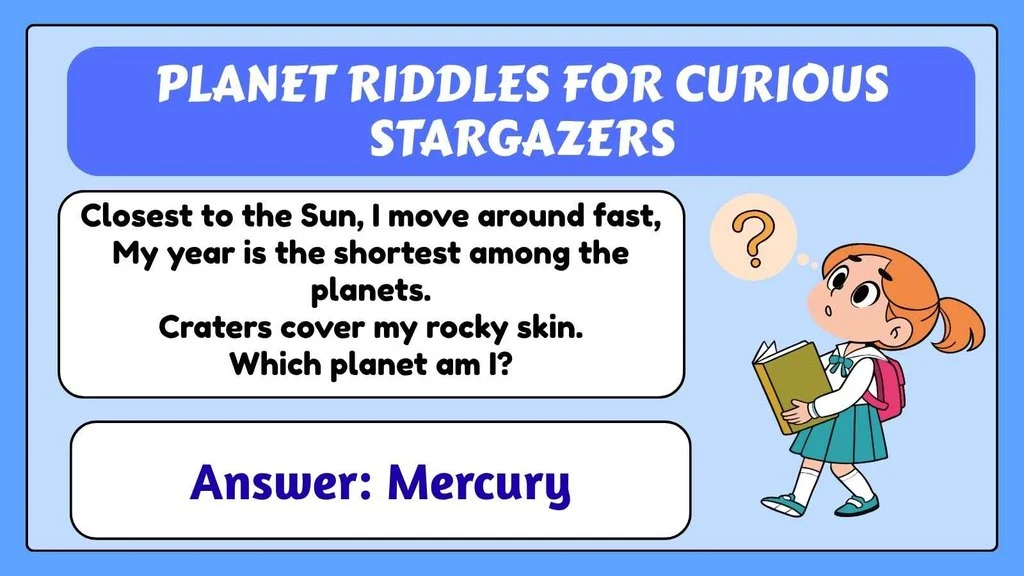
- Closest to the Sun, I move around fast,
My year is the shortest among the planets.
Craters cover my rocky skin.
Which planet am I?Answer: Mercury - Though not nearest the Sun, I hold the heat,
My thick atmosphere makes my surface extreme.
I shine brightly in Earth’s evening sky.
Which planet am I?Answer: Venus - I am the biggest planet circling the Sun,
A giant storm marks my cloudy face.
Many moons travel around me.
Which planet am I?Answer: Jupiter - My rings contain countless icy pieces,
They circle me in broad, bright bands.
I am a giant planet far from the Sun.
Which planet am I?Answer: Saturn - My axis is tilted dramatically,
I seem to roll along as I orbit the Sun.
My atmosphere gives me a blue-green appearance.
Which planet am I?Answer: Uranus - Far from the Sun, I look deep blue,
Strong winds sweep through my atmosphere.
I am the outermost recognized planet.
Which planet am I?Answer: Neptune - I was once called the ninth planet,
But astronomers now classify me differently.
Beyond Neptune, I travel around the Sun.
Which dwarf planet am I?Answer: Pluto - I have oceans, clouds, and a protective atmosphere,
Life as we know it thrives on my surface.
What planet am I?Answer: Earth - My famous storm is large and long-lasting,
Bands of clouds wrap around my enormous body.
Which gas giant am I?Answer: Jupiter - I am named after the Roman god of war,
My surface has volcanoes and ancient valleys.
Which red planet am I?Answer: Mars
Sun and Moon Riddles
The Sun and Moon are familiar sights, but their behavior hides fascinating puzzles. These riddles focus on sunlight, lunar phases, and eclipses.
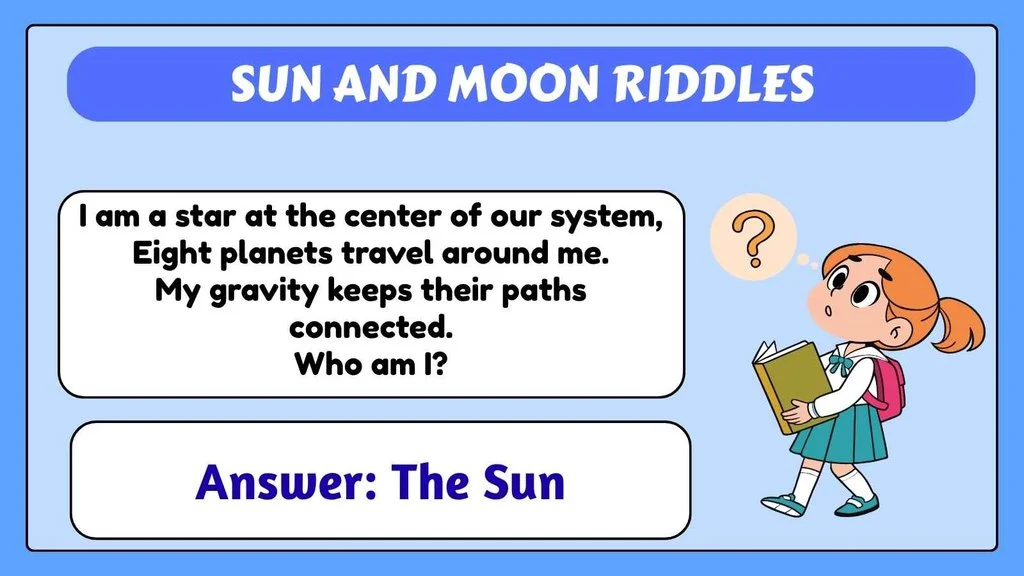
- I am a star at the center of our system,
Eight planets travel around me.
My gravity keeps their paths connected.
Who am I?Answer: The Sun - Sometimes I look like a curved fingernail,
Sometimes a circle shining pale.
My changing shape is an illusion of light.
What am I?Answer: The Moon’s phases - I appear when Earth’s shadow crosses the Moon,
Sometimes I look reddish beneath the night sky.
What celestial event am I?Answer: A lunar eclipse - I happen when the Moon passes between Earth and the Sun,
Daylight can briefly grow dim in some places.
What event am I?Answer: A solar eclipse - I am the point in the Moon’s orbit when it is farthest from Earth,
My name is used by astronomers tracking lunar distance.
What am I called?Answer: Apogee - I am the point in the Moon’s orbit when it is closest to Earth,
I have a name opposite to apogee.
What am I called?Answer: Perigee - I rise when the Sun sets,
My fully lit face appears bright and round.
Which lunar phase am I?Answer: Full Moon - I appear when the Moon lies roughly between Earth and the Sun,
My sunlit side faces away from us.
Which lunar phase am I?Answer: New Moon - I am the imaginary line separating the lit and dark sides of a planetary body,
I can be seen along the Moon’s changing shape.
What am I called?Answer: The terminator - I cause the regular rise and fall of many coastal waters,
My gravity plays a major role, along with the Sun’s.
What am I helping create?Answer: Ocean tides
Funny Space Riddles and Cosmic Jokes
Ready for a little laughter between scientific discoveries? These space riddles use playful misdirection, silly situations, and astronomy-themed wordplay.
- Why did the astronaut carry a notebook into orbit?
The mission was full of new discoveries,
And someone had to keep track of them.
What was the notebook for?Answer: Recording observations - Why did the Moon refuse to join the dance contest?
It was changing phases all week,
And couldn’t settle on one look.
What was its excuse?Answer: It was going through a phase - Why did the star get promoted at work?
It always stood out from the crowd,
And its performance was truly stellar.
What helped it succeed?Answer: Its stellar performance - Why did the alien bring a ruler to space camp?
It wanted to measure the distance between stars,
Even though the numbers were enormous.
What was the ruler for?Answer: Measuring distances, at least in the joke - Why did the rocket refuse to argue with the launch computer?
The countdown was already running,
And neither wanted to lose its temper.
What did the rocket choose?Answer: To keep its cool until launch - What do planets do when they want to stay in touch?
They keep moving along their paths,
Yet gravity keeps them connected to their star.
What is the joke answer?Answer: They stay in orbit around each other - Why did the telescope get invited to every science party?
It always focused on the conversation,
And never missed a detail.
What made it popular?Answer: Its ability to focus - Why did the astronaut take a nap before launch?
The trip would be long,
And staying alert was part of the plan.
What was the reason?Answer: To be well-rested for the mission - What do you call a planet that loves telling stories?
It has a whole world of experiences,
And never runs out of material.
What’s its playful nickname?Answer: A tale-urian - Why did the comet get a haircut?
Its tail had grown too long,
And it wanted a tidier look near the Sun.
What was the reason?Answer: It wanted to trim its tail
Astronaut and Space Exploration Riddles
Space exploration takes careful planning, specialist equipment, and courageous crews. These riddles focus on the people and technology that help us learn about worlds beyond Earth.
- I am a home, laboratory, and workplace in orbit,
Astronauts from different nations have lived aboard me.
What station am I?Answer: The International Space Station - I am a machine sent to explore another world,
I roll over rocks and send scientific data home.
What kind of explorer am I?Answer: A rover - I protect an astronaut’s body in the vacuum of space,
I supply oxygen and help manage temperature.
What am I?Answer: A spacesuit - I travel beyond Earth without a crew,
I send back information about distant objects.
What am I?Answer: An uncrewed space probe - I am a robotic helper with a long mechanical reach,
I can move equipment outside a spacecraft.
What am I?Answer: A robotic arm - I am the countdown’s final step before a rocket rises,
Engines ignite and the vehicle begins its journey.
What event am I?Answer: Liftoff - I help scientists observe planets, stars, and galaxies,
My instruments collect light from distant objects.
What am I?Answer: A space telescope - I bring cargo or crew to an orbiting station,
I dock with a spacecraft instead of landing on a runway.
What am I?Answer: A spacecraft - I help a spacecraft keep its panels pointed toward the Sun,
I also help it maintain the right orientation.
What type of system am I?Answer: An attitude-control system - I am a small vehicle that explores another planet’s surface,
I send images and measurements to mission teams.
What am I?Answer: A planetary rover
Galaxy and Universe Riddles
The universe contains structures far larger than our solar system. Solve these riddles about galaxies, nebulae, black holes, and the cosmic web.
- I contain stars, gas, dust, and dark matter,
Gravity binds my enormous collection together.
Our Sun lives inside one of me.
What am I?Answer: A galaxy - I am a spiral galaxy with a bright central region,
Our solar system lies within one of my arms.
Which galaxy am I?Answer: The Milky Way - I am a vast cloud of gas and dust,
Stars may form inside me under the right conditions.
What am I?Answer: A nebula - My gravity is so strong that light cannot escape from inside my event horizon,
I may form when massive stars collapse or through other processes.
What am I?Answer: A black hole - I am a region of space where galaxies gather in large numbers,
Gravity binds many of my members together.
What am I?Answer: A galaxy cluster - I am an extremely luminous object powered by matter falling toward a supermassive black hole,
I can be seen across enormous distances.
What am I?Answer: A quasar - I am the universe’s early hot, dense state,
My expansion marks the beginning of the universe as described by modern cosmology.
What event am I?Answer: The Big Bang - I am matter that does not emit or absorb light in the usual way,
Astronomers infer my presence largely through gravitational effects.
What am I?Answer: Dark matter - I am a mysterious component associated with the universe’s accelerating expansion,
My exact physical nature remains unknown.
What am I called?Answer: Dark energy - I am a pattern of galaxies, groups, and clusters separated by vast voids,
Across the universe, my structure resembles connected strands.
What am I?Answer: The cosmic web
Rocket and Satellite Riddles
Rockets and satellites help humans reach space, study Earth, and communicate across long distances. See if you can solve these technology-focused puzzles.
- I burn fuel and send exhaust backward,
The resulting force pushes a rocket forward.
What physical principle am I demonstrating?Answer: Newton’s third law of motion - I travel around Earth along a curved path,
Gravity keeps me from flying straight into space.
What is my path called?Answer: An orbit - I circle Earth and help people find their location,
My signals support navigation systems.
What type of satellite am I?Answer: A navigation satellite - I gather sunlight and turn it into electrical energy,
Satellites and spacecraft may use me for power.
What am I?Answer: A solar panel - I am a protective layer designed for the fiery return to Earth,
I help shield a spacecraft from intense heating.
What am I?Answer: A heat shield - I am the part of a rocket that directs hot exhaust,
My shape helps convert the gas’s energy into thrust.
What am I?Answer: A rocket nozzle - I help a satellite study storms and cloud patterns,
Meteorologists use my observations to improve forecasts.
What am I?Answer: A weather satellite - I am a rocket section that drops away when my fuel is spent,
This reduces the mass of the remaining vehicle.
What am I?Answer: A spent rocket stage - I carry radio signals between distant locations,
I orbit high above Earth and help connect communications networks.
What type of satellite am I?Answer: A communications satellite - I help a spacecraft change direction or adjust its path,
I may use small thrusters to make careful corrections.
What system am I?Answer: A spacecraft guidance and control system
Challenging Space Brain Teasers
These advanced riddles explore scientific terms and cosmic phenomena. Read each clue carefully; a small detail may point you toward the correct answer.
- I measure how far light travels in a year,
I help describe distances between stars.
Despite my name, I am not a unit of time.
What am I?Answer: A light-year - I am the invisible boundary around a black hole,
Cross me inward and no signal can escape to the outside.
What am I?Answer: The event horizon - I am the bending of light caused by gravity,
A massive object can distort the view of a distant galaxy.
What phenomenon am I?Answer: Gravitational lensing - I power the Sun by joining light atomic nuclei,
Enormous energy emerges from the process.
What reaction am I?Answer: Nuclear fusion - I am the explosive end of certain stars,
I can scatter newly formed elements into space.
What am I?Answer: A supernova - I am the apparent shift in a nearby star’s position as Earth moves around the Sun,
Astronomers use me to estimate stellar distances.
What am I?Answer: Stellar parallax - I describe how a wave’s wavelength changes when its source and observer move relative to one another,
In distant galaxies, my redshift can reveal cosmic expansion.
What effect am I?Answer: The Doppler effect - I am the boundary separating Earth’s atmosphere from outer space by one common convention,
My altitude is often quoted as about 100 kilometers.
What am I called?Answer: The Kármán line - I am the point in a planet’s orbit where it is closest to the Sun,
My name contrasts with aphelion.
What am I?Answer: Perihelion - I am the point in an orbit where an object is farthest from the Sun,
My name is used when describing comets and planets.
What am I?Answer: Aphelion
Space Riddles About Asteroids, Comets, and Meteors
Space contains many smaller objects that travel around the Sun. These riddles help distinguish asteroids, comets, meteoroids, meteors, and meteorites.
- I orbit the Sun and am made mostly of rock or metal,
Many of my kind travel between Mars and Jupiter.
What am I?Answer: An asteroid - I am an icy body that may grow a glowing cloud near the Sun,
Sunlight and solar wind can help create my tail.
What am I?Answer: A comet - I am a small rocky or metallic object traveling through space,
If I enter Earth’s atmosphere, I may produce a streak of light.
What am I called before that happens?Answer: A meteoroid - I am the bright streak created when space material heats the atmosphere,
People often call me a shooting star.
What am I?Answer: A meteor - I survive the trip through the atmosphere and reach the ground,
Scientists may examine my material to learn about space.
What am I?Answer: A meteorite - I am the region between Mars and Jupiter where many asteroids orbit,
I contain countless rocky bodies of different sizes.
What am I?Answer: The asteroid belt - I orbit the Sun beyond Neptune,
Many icy objects travel through my broad region.
What region am I?Answer: The Kuiper Belt - I am a bright meteor that shines especially intensely,
My flash can briefly illuminate the night sky.
What am I?Answer: A fireball - I occur when Earth passes through debris left along a comet’s path,
Many streaks may appear to radiate from one part of the sky.
What event am I?Answer: A meteor shower - I am a rocky object whose orbit brings me relatively close to Earth’s orbit,
Astronomers monitor objects like me to understand potential hazards.
What am I?Answer: A near-Earth asteroid
Space Riddles for Classroom and Family Games
These shorter, accessible riddles are ideal for reading aloud, group competitions, and quick astronomy review sessions.
- I am the planet with the giant red storm,
My many moons circle my cloudy form.
Which planet am I?Answer: Jupiter - I appear to change shape during the month,
Yet my round body remains the same.
Which object am I?Answer: The Moon - I take pictures of distant galaxies,
I collect light from objects far beyond Earth.
What am I?Answer: A telescope - I help astronauts breathe and stay warm,
Outside their spacecraft, I protect them from harm.
What am I?Answer: A spacesuit - I am a star pattern named after a hunter,
Three bright stars form my famous belt.
Which constellation am I?Answer: Orion - I circle a planet but am not necessarily natural,
Humans build many of my kind for useful tasks.
What am I?Answer: An artificial satellite - I am a rocky planet with the tallest known volcano in the solar system,
My red surface holds many signs of ancient activity.
Which planet am I?Answer: Mars - I am a distant object made of ice and rock,
My tail can grow when solar warmth affects me.
What am I?Answer: A comet - I am a giant collection of stars,
Our solar system belongs to my spiral structure.
What am I?Answer: The Milky Way - I lift spacecraft away from Earth’s surface,
My engines produce the force needed to climb.
What am I?Answer: A rocket
How to Use Space Riddles for Fun and Learning
Space riddles are easy to adapt for science lessons, family activities, birthday parties, and astronomy clubs. Try these simple ideas to turn the collection into an interactive experience.
- Run a team quiz: Divide players into teams and give each group a mix of easy and challenging questions.
- Start a science lesson: Use a short riddle as a warm-up, then discuss the scientific idea behind the answer.
- Create a space-themed treasure hunt: Place clue cards around a room and let each solved answer lead to the next location.
- Use a no-peeking rule: Ask everyone to write down a guess before revealing the solution.
- Add drawing challenges: Have younger children draw the planet, star, or spacecraft described in the riddle.
- Award explanation points: Give an extra point when a player explains which clue helped them solve the puzzle.
- Share a daily space question: Post one riddle in a family group chat or classroom forum to encourage curiosity between activities.
For younger participants, explain unfamiliar vocabulary such as orbit, nebula, and meteorite. For older players, use the advanced section to spark a deeper discussion about astronomy.
FAQs:
What are the easiest space riddles for kids?
Riddles about the Sun, Moon, Earth, rockets, and astronauts are good starting points because their clues connect to familiar objects and experiences.
Are space riddles educational?
Yes, they can reinforce astronomy vocabulary, encourage logical thinking, and help learners remember scientific concepts through clues and discussion.
What is the difference between a meteor and a meteorite?
A meteor is the visible streak produced when space material enters the atmosphere, while a meteorite is a fragment that reaches the ground.
Can space riddles be used in school?
Yes, teachers can use them as lesson starters, review questions, reading exercises, or team-based science activities.
How can I make astronomy riddles harder?
Choose clues involving orbital mechanics, stellar evolution, distant galaxies, and space technology, while ensuring each question contains enough information to solve it.
How do you organize a space riddle competition?
Divide participants into teams, award points for correct answers, and offer bonus points for explaining the scientific reasoning behind a solution.
Conclusion:
These space riddles offer more than a quick guessing game: they encourage curiosity about the planets, stars, and scientific discoveries that make our universe fascinating. Whether you’re entertaining young learners, testing a seasoned astronomy fan, or adding a cosmic twist to family game night, there’s a challenge for every level. Start with the easy clues, move into the trickier brain teasers, and discuss the science behind the answers. You might discover a new favorite topic along the way. Share your favorite riddle, challenge a friend to beat your score, and keep exploring the wonders above us!
