
Looking for riddles like Green Glass Door that make everyone think twice before answering? The classic Green Glass Door game is a word puzzle built around a hidden rule: some words can pass through the imaginary door, while others cannot. Players must figure out the pattern by testing examples, listening carefully, and spotting what accepted words have in common.
The fun comes from the discovery. At first, the rule may seem completely random, but a small detail in the spelling reveals the secret. Once someone understands it, they can challenge the group with new words and see who catches on first.
This collection includes Green Glass Door-style word games, hidden-letter riddles, spelling puzzles, sound-based challenges, logic questions, and tricky brain teasers for kids, teens, and adults. Each puzzle includes an answer so you can learn the rule or use it to host your own game. Try guessing before you peek—some of these puzzles are much easier once you stop focusing on what the words mean and start examining how they are written.
💡 Did You Know?
- Green Glass Door is a type of hidden-rule word game, often played orally in groups.
- In the familiar version, a word is allowed when it contains a doubled letter, such as the double e in “green” or the double s in “glass.”
- Word puzzles can rely on different features, including spelling, sounds, letter positions, word meanings, or numerical patterns.
🎯 Riddle of the Day
- Through my secret doorway, a balloon may float,
But a single kite cannot enter the moat.
A rabbit gets in, while a hare waits outside—
What hidden spelling rule controls this ride?Answer: The words must contain a doubled letter. “Balloon” has “ll,” and “rabbit” has “bb,” while “kite” and “hare” do not.
Green Glass Door Riddles With Answers
These examples use the classic doubled-letter rule. In this version, a word is allowed through the imaginary door if it contains two identical letters next to each other.
- A green glass door welcomes coffee but rejects tea. What makes the difference?Answer: “Coffee” contains “ff,” while “tea” has no doubled letters.
- You may bring a kitten inside, but a cat must stay outside. Why?Answer: “Kitten” contains “tt,” while “cat” has no doubled letters.
- A moon can pass through the door, but a star cannot. What is the secret?Answer: “Moon” contains “oo,” while “star” has no doubled letters.
- The door accepts a balloon but refuses a kite. What rule is it following?Answer: “Balloon” contains “ll,” while “kite” has no doubled letters.
- A puppy can enter, but a dog cannot. Why?Answer: “Puppy” contains “pp,” while “dog” has no doubled letters.
- You can take a spoon inside, but a fork is not allowed. What makes one word qualify?Answer: “Spoon” contains “oo,” while “fork” has no doubled letters.
- The door lets in cheese but turns away bread. Can you explain why?Answer: “Cheese” contains “ee,” while “bread” has no doubled letters.
- A rabbit may hop inside, but a hare must wait. What does the door notice?Answer: “Rabbit” contains “bb,” while “hare” has no doubled letters.
- A book may enter, but a novel cannot. What is the clue?Answer: “Book” contains “oo,” while “novel” has no doubled letters.
- The door allows a butterfly but rejects a moth. What is the hidden pattern?Answer: “Butterfly” contains “tt,” while “moth” has no doubled letters.
Green Glass Door Word Games for Kids
These kid-friendly examples are easy to test aloud. Ask children to suggest another word that follows the rule before revealing the answer.
- A puppet may enter the room, but a doll is not allowed. Which word has the required spelling pattern?Answer: “Puppet” contains “pp” and “tt.” Note that “doll” also contains “ll,” so under the doubled-letter rule, “doll” must be allowed too.
- The door welcomes a zoo but refuses a farm. What does the accepted word contain?Answer: “Zoo” contains “oo,” while “farm” has no doubled letters.
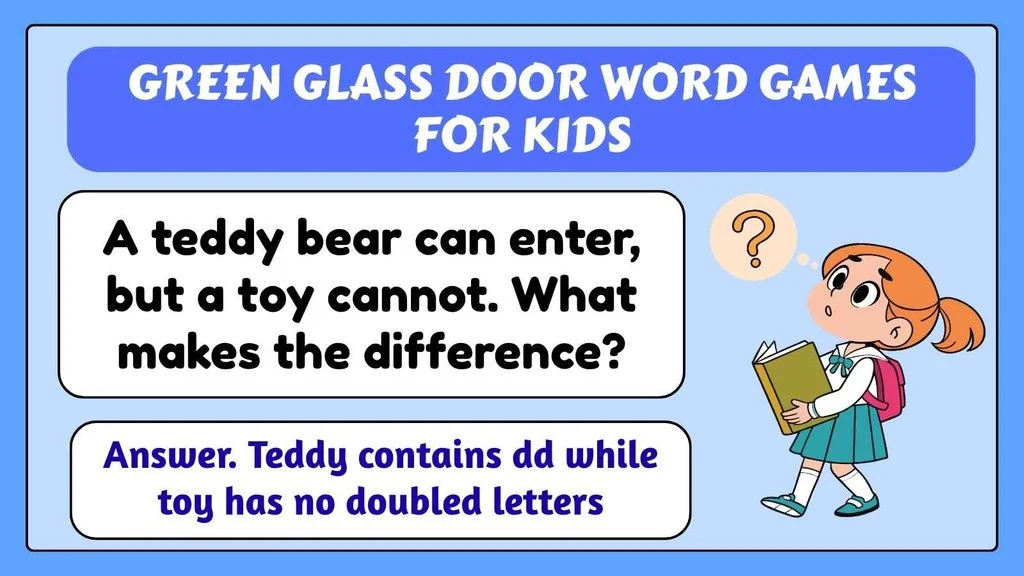
- A teddy bear can enter, but a toy cannot. What makes the difference?Answer: “Teddy” contains “dd,” while “toy” has no doubled letters.
- A pillow is allowed inside, but a blanket is not. What is the rule?Answer: “Pillow” contains “ll,” while “blanket” has no doubled letters.
- You may bring a cookie, but not a cracker. Which spelling feature matters?Answer: “Cookie” contains “oo,” while “cracker” has no doubled letters.
- A puppet can enter, but a robot cannot. What does the door check?Answer: “Puppet” contains doubled letters, while “robot” does not.
- The door accepts jelly but rejects jam. Why?Answer: “Jelly” contains “ll,” while “jam” has no doubled letters.
- A kitten can come in, but a puppy is turned away. Is the door being fair?Answer: Both should be allowed because “kitten” has “tt” and “puppy” has “pp.”
- You can carry a ball through the door, but not a bat. What makes one word qualify?Answer: “Ball” contains “ll,” while “bat” has no doubled letters.
- A dinner invitation is accepted, but a lunch invitation is not. What is the secret?Answer: “Dinner” contains “nn,” while “lunch” has no doubled letters.
Tricky Hidden-Letter Riddles
These puzzles use letter patterns and spelling details. Some follow the doubled-letter idea, while others ask you to spot a different feature.
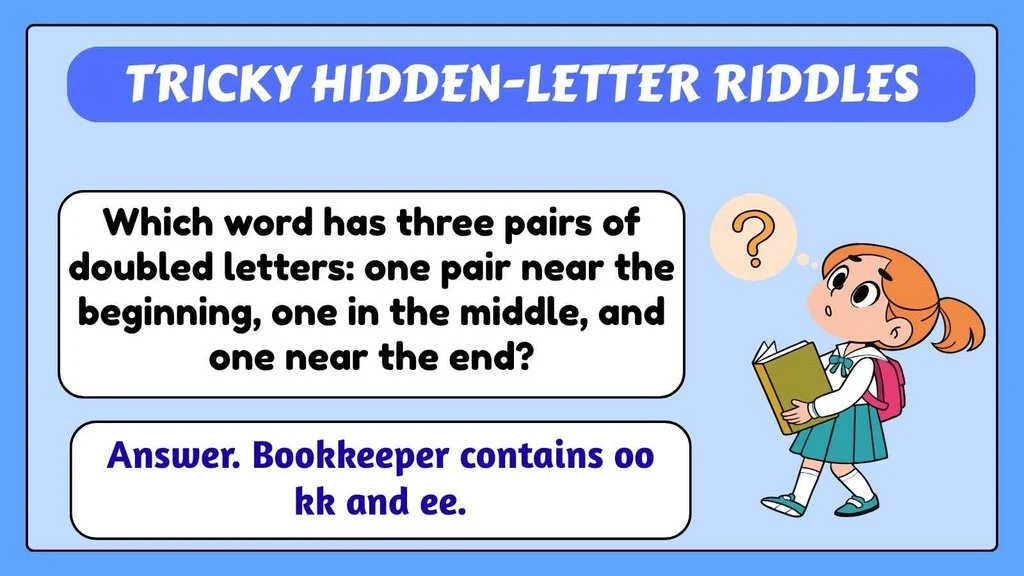
- Which word has three pairs of doubled letters: one pair near the beginning, one in the middle, and one near the end?Answer: “Bookkeeper” contains “oo,” “kk,” and “ee.”
- What common word has two consecutive letters that appear twice in a row?Answer: “Committee” contains “mm” and “tt,” along with “ee” at the end.
- Which word contains a doubled letter but names something you can wear on your feet?Answer: “Slippers” contains “pp.”
- Which word can describe a noisy crowd and contains a repeated consonant?Answer: “Commotion” contains “mm.”
- What word for a place to sleep contains two identical letters together?Answer: “Bedroom” has no doubled letters, but “mattress” contains “tt” and “ss.”
- Which word describes something sweet and sticky and contains a double letter?Answer: “Honey” has no doubled letters, but “jelly” contains “ll.”
- What word means a mistake and contains a pair of matching letters?Answer: “Blunder” has no doubled letters, but “error” contains “rr.”
- Which word for a small, quick animal has a doubled consonant?Answer: “Squirrel” contains “rr.”
- What word for a written message has two matching letters side by side?Answer: “Letter” contains “tt.”
- Which word means to discuss something and has a doubled consonant?Answer: “Address” contains “dd” and “ss.”
Riddles Like Green Glass Door Using Different Rules
Not every hidden-rule game depends on doubled letters. These examples introduce other patterns. Tell players that each round has its own rule, then let them figure it out.
- A secret gate accepts cat, dog, and pig, but rejects horse and rabbit. What kind of rule might fit these examples?Answer: The accepted words have three letters.
- A word puzzle allows apple, orange, and grape, but not bread. What possible rule could be at work?Answer: The accepted words are fruit names.
- A mystery box accepts Monday, Tuesday, and Friday, but rejects January. What category explains the examples?Answer: Days of the week.
- A magic door accepts red, blue, and green, but rejects circle. What kind of words belong inside?Answer: Color words.
- A hidden club welcomes whisper, murmur, and shout, but rejects silent. What do the accepted words share?Answer: They describe ways of making sound.
- A word gate allows run, jump, and swim, but refuses chair. What is the rule?Answer: The accepted words are verbs describing actions.
- A puzzle accepts inch, foot, and yard, but rejects pound. What category fits the accepted words?Answer: Units of length.
- A secret list contains January, March, and May, but excludes Monday. What do the included words represent?Answer: Months of the year.
- A gate accepts triangle, square, and hexagon, but rejects purple. What belongs through?Answer: Names of geometric shapes.
- A word game welcomes sparrow, eagle, and robin, but not salmon. What is the pattern?Answer: The accepted words name birds.
Green Glass Door Logic Puzzles
These brain teasers move beyond spelling and ask you to reason carefully. Read each question before looking at its solution.
- A room has four corners, and a cat sits in each corner. Every cat can see the other three. How many cats are in the room?Answer: Four cats. Each cat can see the other three.
- You have five candles burning. Two are blown out, while the others burn completely away. How many candles remain?Answer: Two candles remain—the ones that were blown out.
- A farmer has 17 sheep, and all but 9 wander away. How many are left?Answer: Nine sheep. “All but 9” means 9 stay.
- A bus starts empty. At the first stop, three people get on. At the next stop, one gets off and four get on. How many passengers are on the bus?Answer: Six passengers.
- You enter a dark room with a candle, a fireplace, and a lantern. You have one match. What do you light first?Answer: The match.
- A clock takes five seconds to strike five times, with equal time between strikes. How long does it take to strike ten times?Answer: 11.25 seconds, assuming the same interval between strikes: five strikes have four intervals, each 1.25 seconds long, so ten strikes have nine intervals.
- A person has two coins totaling 30 cents, and one of them is not a nickel. What are the coins?Answer: A quarter and a nickel. One coin is not a nickel—the quarter.
- You have six eggs. You break two, cook those two, and eat those two. How many eggs are left unused?Answer: Four eggs. The same two eggs were broken, cooked, and eaten.
- A farmer must take a fox, a chicken, and a bag of grain across a river. The boat carries the farmer and only one item at a time. How can everything cross safely?Answer: Take the chicken across, return alone, take the fox across, bring the chicken back, take the grain across, return alone, then take the chicken across.
- A person looks at a photograph and says, “I have no siblings, but that person’s father is my father’s son.” Who is in the photograph?Answer: The person’s child. “My father’s son” refers to the speaker.
Wordplay Riddles for Friends
These puzzles are ideal for sharing with friends. The clues rely on word meanings, familiar expressions, or a small twist in interpretation.
- What word becomes shorter when you add two letters to it?Answer: “Short” becomes “shorter” when you add “er.”
- What has many keys but cannot unlock a door?Answer: A piano.
- What has a head and a tail but no body?Answer: A coin.
- What can travel around the world while staying in one corner?Answer: A postage stamp.
- What gets wetter the more it dries?Answer: A towel.
- What has one eye but cannot see?Answer: A needle.
- What can you break without touching it?Answer: A promise.
- What has hands but cannot clap?Answer: A clock.
- What can fill a room without taking up physical space?Answer: Light.
- What has words but never speaks?Answer: A book.
Hard Word Pattern Riddles
Ready for a tougher challenge? These puzzles ask you to examine letters, sounds, and sequences rather than simply guess a familiar object.
- Which English word contains three consecutive double-letter pairs?Answer: “Bookkeeper” is often cited for its doubled-letter pairs, but they are not all consecutive pairs in a row. A precise example of three consecutive doubled pairs is “bookkeeping”: “oo,” “kk,” and “ee” appear in that order.
- What word begins and ends with the same letter and contains another identical letter in the middle?Answer: “Radar” begins and ends with “r” and has another “r” in the middle? No—“radar” has two r’s, at the beginning and end.
- Which word contains the letters of “listen” rearranged to make another common word?Answer: “Silent.”
- What five-letter word becomes a different word when you remove its first letter, and becomes another word when you remove its last letter?Answer: “Plane” becomes “lane” when you remove the first letter and “plan” when you remove the last.
- Which word can mean both a type of tree and a material used in building?Answer: “Pine.”
- What word contains a letter that appears once in “minute,” twice in “moment,” and never in “hour”?Answer: The letter “m.”
- Which word sounds the same as a number but has a different spelling and meaning?Answer: “Won,” which sounds like “one.”
- What word can mean both to look quickly and a small mark or stain?Answer: “Spot.”
- Which word changes from an animal to a different word when you add one letter at the beginning: “rat”?Answer: “Strat” is not a common standalone word, so this is a trick question with no ordinary answer under the stated condition.
- What word has a double letter that changes its pronunciation compared with a single-letter spelling in another word?Answer: “Dinner” has “nn,” while “diner” has one “n” and a different pronunciation and meaning.
How to Play Green Glass Door With a Group
The best way to enjoy this game is to keep the rule secret until players have had a chance to test their ideas.
- Choose a host: One person knows the hidden rule and gives examples of words that can or cannot pass.
- Invite guesses: Players suggest words and ask whether each one is allowed through the door.
- Offer balanced clues: Include both accepted and rejected examples so the pattern can be discovered fairly.
- Ask for explanations: Encourage players to explain why a word fits instead of guessing randomly.
- Change the rule for a new round: Try categories, word lengths, rhyming patterns, or letters in specific positions.
- Keep it friendly: The goal is to discover the rule and enjoy the surprise, not to make anyone feel foolish.
For the classic version, remember that words with doubled letters are allowed. Examples include “green,” “glass,” “book,” “pillow,” and “kitten.” Words such as “blue,” “door,” “chair,” and “table” do not qualify under that rule.
FAQs:
What are riddles like Green Glass Door?
They are hidden-rule word games where players test examples and work out the spelling, sound, or category that determines which words are allowed.
What is the rule of the Green Glass Door game?
In the common version, a word can pass through the door if it contains two identical letters next to each other, such as “ee” in “green.”
How do you win Green Glass Door?
You solve the game by correctly identifying the hidden rule and using it to decide which new words can pass.
Are Green Glass Door riddles good for kids?
Yes, the game can help children practice spelling patterns, careful listening, and logical thinking while playing with others.
Can I make my own Green Glass Door-style puzzle?
Yes, choose a consistent hidden rule—such as doubled letters, word length, or a category—and provide examples that let players discover it.
What are some games similar to Green Glass Door?
Try hidden-category word games, “I’m going on a picnic” memory games, spelling-pattern challenges, and riddles that depend on a secret rule.
Conclusion:
Riddles like Green Glass Door are entertaining because they turn ordinary words into a mystery that players must solve together. Start with the classic doubled-letter rule, then explore hidden categories, spelling patterns, logic puzzles, and clever wordplay for a fresh challenge. Whether you’re hosting a family game night, keeping students engaged, or testing friends, these riddles offer plenty of opportunities to guess, rethink, and laugh. Remember to give players enough examples to uncover the pattern fairly. Which puzzle gave you the biggest challenge? Share your favorite with a friend and see whether they can crack the hidden rule!
