
Baseball is full of exciting moments, unexpected plays, and clever strategies—and it also makes a great subject for brain teasers. These baseball riddles bring the fun of the ballpark into a collection of puzzles that challenge your thinking while celebrating the game. Whether you’re a young player learning the basics, a longtime fan who follows every inning, or a parent looking for an entertaining activity, you’ll find plenty to enjoy.
Inside this collection, you’ll discover easy baseball riddles for kids, funny questions for teammates, tricky puzzles for devoted fans, and wordplay inspired by bats, balls, bases, pitchers, catchers, and home runs. Every riddle includes an answer, so you can test yourself before checking the solution or challenge someone else to solve it first.
Use these baseball brain teasers during a road trip, at a team gathering, in a classroom activity, or while watching a game with friends. Some are quick warm-ups, while others require a little more thought. Grab your imaginary glove, step up to the plate, and see how many you can solve without striking out!
💡 Did You Know?
- A regulation baseball has nine innings in a standard game, although extra innings may be played when the score is tied.
- A baseball field has four bases: first base, second base, third base, and home plate.
- In baseball, a batter can reach home plate after touching all three bases in order, completing a run.
🎯 Riddle of the Day
- I wait in the dirt while the crowd holds its breath,
Three turns around me can lead to success.
Touch me, then home, and your team may score—
What corner of baseball are players racing toward?Answer: Third base.
Ready for more? Explore the collection below, from simple puzzles to clever baseball wordplay.
Easy Baseball Riddles for Kids
These beginner-friendly riddles are ideal for young baseball fans, school activities, and family game nights.
- I have four corners, but I am not a square room.
Players race to reach me before their chances are gone.
What am I?Answer: A baseball diamond. - I am round, small, and covered in stitches.
Hit me with a bat, and I may fly over the fences.
What am I?Answer: A baseball. - Players wear me on their hands to catch a flying ball.
I have a pocket but hold no money at all.
What am I?Answer: A baseball glove. - I stand behind the batter and protect the space.
With a mask and mitt, I help control the pace.
Who am I?Answer: The catcher. - I am a special place where the batter begins.
A safe trip around the bases can bring the team wins.
What am I?Answer: Home plate. - I have a mound but no mountain trail.
A player throws from me to make a batter fail.
What am I?Answer: The pitcher’s mound. - I am called out when a batter misses three times under the rules.
Hearing my name can send a player back to the dugout.
What am I?Answer: A strikeout. - I help a player run faster without wearing shoes.
I come in pairs and have metal or molded grips.
What am I?Answer: Baseball cleats. - I keep players together when they are not on the field.
They cheer for their teammates and prepare for their turn.
What am I?Answer: The dugout. - I appear when a batter circles every base and reaches home safely.
The scoreboard adds one because of me.
What am I?Answer: A run.
Funny Baseball Riddles
These playful baseball riddles are great for sharing with teammates, friends, and anyone who enjoys a little sports humor.
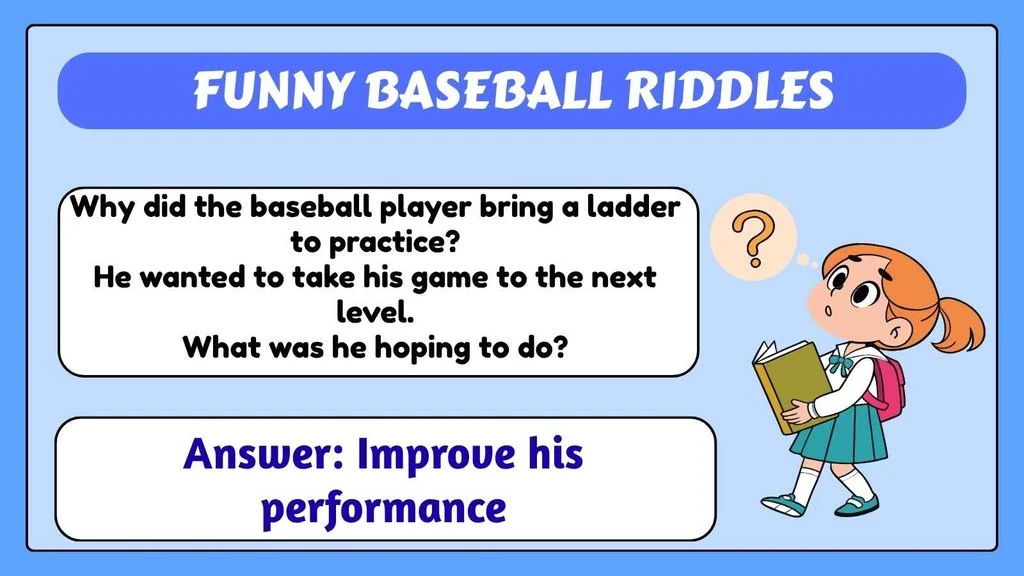
- Why did the baseball player bring a ladder to practice?
He wanted to take his game to the next level.
What was he hoping to do?Answer: Improve his performance. - What does a baseball do when it wants to relax?
It stops rolling and takes a little break.
Where might you find it?Answer: Resting in a glove or on the ground. - Why did the bat refuse to tell a secret?
It didn’t want the whole team to hear it.
What was it afraid of?Answer: Letting the secret slip. - What kind of music does a baseball player enjoy before a big game?
Something that keeps the rhythm moving.
What is it?Answer: A good hit tune. - Why did the baseball player bring a pencil to the field?
He wanted to make a note of every great play.
What was he ready to do?Answer: Keep score. - What happens when a baseball team gets too cold?
The players huddle together and wait for the next inning.
What do they need?Answer: A warm-up. - Why did the baseball glove get promoted?
It always caught the important opportunities.
What made it stand out?Answer: Its ability to catch everything that mattered. - Why was the baseball game so good at telling stories?
Every inning had a new chapter.
What made the story exciting?Answer: The changing action of the game. - What did the outfielder say to a ball that kept falling short?
He wanted it to aim a little higher.
What was the advice?Answer: Reach for the sky. - Why did the baseball player bring a map?
He wanted to make sure he knew his way around the bases.
What was he learning?Answer: The route to home plate.
Tricky Baseball Brain Teasers
These puzzles require a closer look at the clues. Read carefully before deciding on an answer.
- A batter hits a ball that never leaves the infield, yet reaches first base safely. How?
Think about a play where the defense cannot complete an out.
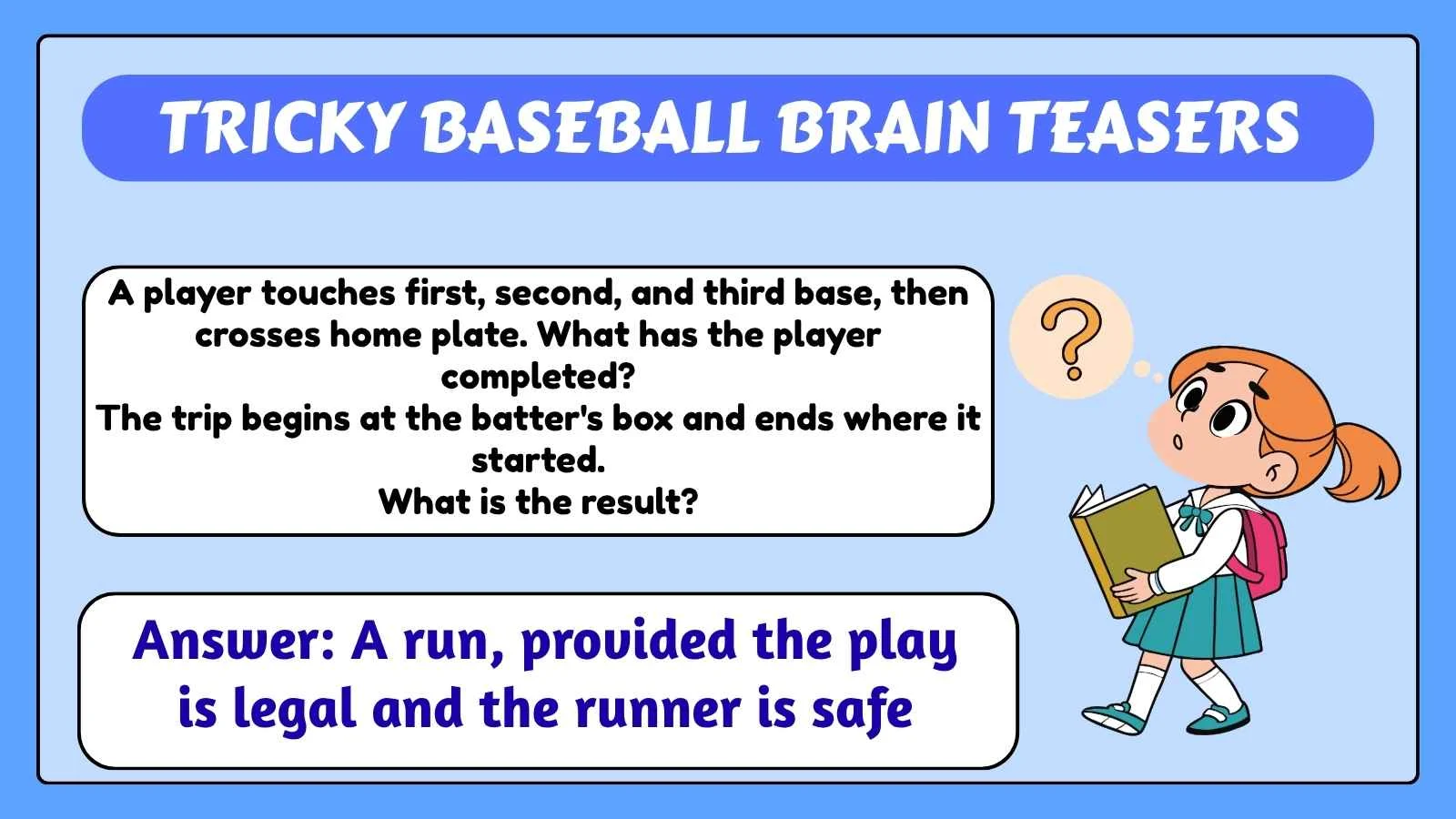
What might have happened?Answer: The batter hit a slow infield grounder and beat the throw to first. - A player touches first, second, and third base, then crosses home plate. What has the player completed?
The trip begins at the batter’s box and ends where it started.
What is the result?Answer: A run, provided the play is legal and the runner is safe. - A ball is hit high into the air, but the batter is called out before it touches the ground. What happened?
The defense never needed to chase a ground ball.
What kind of play was it?Answer: A fly-ball catch. - A pitcher throws a ball that the batter does not swing at. It still counts against the batter. What could it be?
The umpire’s call matters as much as the batter’s choice.
What is the pitch called?Answer: A called strike. - A runner is standing on second base when the batter hits a single. The runner reaches home safely. How many bases did the runner advance?
Start counting from the base where the runner began.
What is the total?Answer: Two bases, from second to third and then home. - A baseball game has nine innings scheduled, but the teams keep playing after the ninth. Why?
The scoreboard has not settled the contest.
What is this extra play called?Answer: Extra innings. - A batter hits a fair ball that bounces over the outfield fence. What can happen?
The ball crosses the boundary after touching the field.
What might the ruling be?Answer: A ground-rule double, depending on the applicable field rules. - A player catches a ball while standing in fair territory, then steps into foul territory. Does the catch automatically become a foul ball?
Consider where the ball was when it was caught.
What matters most?Answer: The catch’s status is determined by the ball’s location and the applicable rules at the time of the catch. - A runner reaches first base without hitting the ball. How can that happen?
The batter may be awarded the base rather than earning it with a hit.
What is one possible reason?Answer: The batter was walked or hit by a pitch, subject to the rules. - The score is tied after the final scheduled inning, but the game is not over. What must happen next?
Both teams need a chance to change the score.
What happens?Answer: Extra innings are played, unless a special game rule or circumstance ends the game.
Baseball Riddles About Bats and Balls
Explore the equipment that makes baseball possible with these object-based riddles.
- My long, narrow body meets the ball with a crack.
Players grip my handle and swing me back.
What am I?Answer: A baseball bat. - My skin is white, my stitches are red,
I may fly high or roll instead.
What am I?Answer: A baseball. - I cover a player’s hand and help secure a catch.
My shape is made for grabbing, not holding cash.
What am I?Answer: A baseball glove. - I protect the batter’s head from a dangerous hit.
Players wear me when they stand ready at the plate.
What am I?Answer: A batting helmet. - I protect a catcher’s face when pitches fly fast.
I help shield the player from an impact that could last.
What am I?Answer: A catcher’s mask. - I am worn on the feet when players run.
My grip helps them turn, stop, and have fun.
What am I?Answer: Baseball cleats. - I sit on the ground and mark where the pitcher aims to throw.
I am small, white, and central to the game.
What am I?Answer: The pitcher’s rubber. - I have a padded shape and straps to keep me in place.
Catchers wear me to protect their chest and waist.
What am I?Answer: Catcher’s protective gear. - I help a player practice swings before stepping up to bat.
I may be tossed gently or placed on a stand.
What am I?Answer: A practice ball. - I record every ball, strike, and out during the game.
I help fans follow the action without guessing.
What am I?Answer: The scoreboard or scorebook, depending on the clue.
Baseball Riddles About Players and Positions
Can you identify the player from the role described? These riddles cover common positions and responsibilities.
- I stand on the mound and send the ball toward home.
My delivery can challenge every batter who comes.
Who am I?Answer: The pitcher. - I crouch behind the plate and receive each throw.
I signal for pitches and help the defense flow.
Who am I?Answer: The catcher. - I guard the bag where every batter hopes to arrive.
I handle many throws to keep runners from staying safe.
Who am I?Answer: The first baseman. - I cover the space between second and third.
Quick hands and sharp reactions are part of my work.
Who am I?Answer: The shortstop. - I patrol the grass beyond the infield dirt.
I chase deep hits and try to prevent extra bases.
Who am I?Answer: An outfielder. - I stand near second base and handle grounders with care.
I help turn double plays when runners are there.
Who am I?Answer: The second baseman. - I defend the corner on the left side of the infield.
Hard-hit ground balls often come my way.
Who am I?Answer: The third baseman. - I stand in the batter’s box and try to hit the pitch.
My goal may be a single, a double, or a home run.
Who am I?Answer: The batter. - I run the bases after the ball is hit.
My speed and judgment can help my team score.
Who am I?Answer: A baserunner. - I make decisions about balls, strikes, and outs.
My calls help keep the game moving fairly.
Who am I?Answer: An umpire.
Baseball Riddles About Rules and Scoring
These riddles test your knowledge of how baseball games work. A few include details that experienced fans will recognize.
- A batter swings and misses at three pitches that are called strikes. What is the usual result?
The plate appearance ends with a defensive win.
What is it called?Answer: A strikeout. - A batter hits the ball over the outfield fence in fair territory with the bases empty. What does the batter usually earn?
The runner circles all four bases.
What is the play?Answer: A solo home run. - A batter hits a fair ball and reaches second base safely without an error or an unusual ruling. What is the hit called?
The batter has gone beyond first but stopped short of third.
What is it?Answer: A double. - A pitcher throws four balls outside the strike zone, and the batter does not swing at them. What may the batter receive?
The batter gets to leave the plate for a base.
What is the award?Answer: A walk, or base on balls. - The defense records three outs in the bottom half of an inning. What happens next in a standard game?
The teams prepare to switch roles.
What begins?Answer: The next half-inning or inning, depending on which half just ended. - A batter hits a ball into foul territory and it is caught before touching the ground. What is the usual result?
The defense catches the ball cleanly.
What happens to the batter?Answer: The batter is out. - A runner leaves a base too early on a caught fly ball and must return to touch it again. What is the runner doing?
The runner is correcting a base-running mistake.
What is the action called?Answer: Tagging up. - A fielder catches a fair ball before it touches the ground. What happens to the batter?
The defense has completed a catch.
What is the ruling?Answer: The batter is out. - A batter hits a ball and reaches first safely while a teammate already on base advances. What might the batter have recorded?
The play begins with contact and ends with a safe arrival.
What is one common result?Answer: A base hit, if the official scorer rules it a hit. - The teams finish a game with different numbers on the scoreboard. What determines the winner?
The game has reached its final result.
What matters?Answer: The team with more runs, subject to the game’s rules.
Hard Baseball Riddles for Serious Fans
These more challenging riddles combine baseball terminology, strategy, and careful interpretation.
- I can happen when a batter reaches first, a runner advances, and the defense records an out elsewhere. My name describes a sacrifice of one player’s chance for another’s progress. What am I?Answer: A sacrifice play, such as a sacrifice bunt or sacrifice fly, depending on the play.
- A runner is on first base with fewer than two outs. The batter hits a ground ball, and the defense gets the runner at second and then the batter at first. What has the defense made?Answer: A double play.
- A batter hits a ball that lands safely in the outfield and rolls to the wall. The batter reaches third without an error. What kind of hit is it?Answer: A triple.
- I am not a hit, but I can still help a runner advance. The batter deliberately taps the ball toward the infield. What am I?Answer: A bunt.
- I can end an inning without a fielder touching the ball. A runner may be declared out for violating a rule. What am I?Answer: A rule-based out, such as an out for interference or leaving a base too early in certain situations.
- A pitcher throws a pitch that the batter swings at and misses, but the catcher fails to secure it. Under certain conditions, the batter may try to reach first. What situation is this?Answer: A dropped third strike.
- I describe a hit that scores a run while allowing the batter to reach base safely. My name depends on how many bases the batter earns. What am I?Answer: An RBI-producing hit, such as a single, double, triple, or home run.
- A runner reaches home because the batter hits a fly ball deep enough for a sacrifice, and the defense catches it. What kind of play can score the runner?Answer: A sacrifice fly.
- I am a statistic that measures how often a batter gets a hit compared with official at-bats. What am I?Answer: Batting average.
- A pitcher allows no hits during a complete game, but opposing batters may still reach base through walks or errors. What achievement has the pitcher recorded?Answer: A no-hitter.
Baseball Wordplay Riddles
These puzzles use baseball language and familiar expressions to challenge your sense of wordplay.
- I’m something you can hit in baseball and also a phrase for reaching a goal. What am I?Answer: A home run.
- I can mean a player is removed from a game, but outside baseball, I can also mean someone is no longer included. What am I?Answer: Being out.
- I can be a place where a player rests between turns, or a place where people wait for their chance. What am I?Answer: The dugout.
- I’m a baseball term and a way to describe a difficult situation with little room for error. What am I?Answer: A tight spot, like a full count with runners on base.
- I’m a kind of hit, but people also use my name to describe a small amount of success. What am I?Answer: A single.
- I can mean a player’s turn at the plate, and it can also describe an opportunity to try something. What am I?Answer: An at-bat.
- I’m a ball that doesn’t count as a strike when I land outside the proper area, but I can also describe someone who is not part of a group. What am I?Answer: A foul.
- I’m a word for a player who throws the ball, and also someone who starts an idea or event. Who am I?Answer: A pitcher.
- I can be a baseball statistic or a person’s reputation for being dependable. What am I?Answer: A record.
- I’m a word that can describe a ball leaving the park or a person doing something exceptionally well. What am I?Answer: Crushing it.
Baseball Riddles for Team Games and Parties
Use these quick challenges to get players, families, and fans talking before a game or during a break.
- The whole team wants me, but no one can hold me in a glove. I appear when the scoreboard changes in our favor. What am I?Answer: A lead.
- I begin when the umpire signals play and pause when the action stops. I contain pitches, swings, and defensive plays. What am I?Answer: A baseball game.
- I am a player’s chance to face the pitcher and help the team score. When I end, another teammate may step in. What am I?Answer: A plate appearance.
- I bring teammates together before the first pitch. Players use me to share encouragement and plans. What am I?Answer: A team huddle.
- I may be drawn on a board or written in a book. I show who scored and when. What am I?Answer: A scorecard.
- I travel from the pitcher toward the catcher, but a batter may send me in another direction. What am I?Answer: A pitch.
- I can be a close call at first base, and everyone in the stands waits to hear the umpire. What am I?Answer: A safe-or-out call.
- I am a group of players who take the field together and work toward the same score. What am I?Answer: A baseball team.
- I am a place where fans sit, cheer, and watch the game unfold. What am I?Answer: The stands or grandstand.
- I arrive when the final out is made and the result is settled. Players shake hands or celebrate, depending on the outcome. What am I?Answer: The end of the game.
How to Use Baseball Riddles
Baseball riddles can make a game day more interactive, whether you’re with young players, friends, or a group of dedicated fans.
- For kids: Start with equipment and position riddles, then introduce simple scoring questions as they learn the rules.
- For teammates: Read a riddle aloud during warm-ups or a team gathering and let everyone guess before revealing the answer.
- For parties: Divide guests into teams and award a point for each correct answer.
- For road trips: Take turns reading riddles without looking at the answers, making the journey more entertaining.
- For social media: Share a single riddle and invite followers to comment with their guesses before posting the solution.
- For baseball fans: Use the rule-based and statistics riddles to spark friendly discussions about the finer details of the game.
For the best experience, mix easy questions with a few harder ones. Give everyone a chance to answer, and explain the relevant rule if a puzzle starts a debate.
FAQs:
What are baseball riddles?
Baseball riddles are short puzzles built around the sport’s equipment, players, rules, scoring, and terminology.
Are these baseball riddles suitable for kids?
Yes, many are family-friendly, and the easier sections are especially suitable for children who enjoy sports and word games.
How can I make baseball riddles more challenging?
Use the harder rule-based puzzles, hide the answer until everyone has guessed, or ask players to explain how the clues support their solutions.
Can I use baseball riddles at a team party?
Absolutely—read them aloud, split participants into teams, and award points for correct answers to create a simple group game.
Do baseball riddles help children learn the game?
They can reinforce familiarity with baseball equipment, positions, and basic rules while giving children a fun reason to think about the sport.
What makes a good baseball riddle?
A good baseball riddle uses clear clues, an interesting twist, and an answer that makes sense once the solution is revealed.
Conclusion:
Baseball is about more than big hits and close plays; it’s also a sport full of language, strategy, and details worth exploring. These baseball riddles offer something for young players, families, casual viewers, and experienced fans, from easy equipment puzzles to challenging questions about rules and scoring. Use them to spark conversation, add fun to a team gathering, or keep everyone entertained between innings. You can even create a friendly competition to see who solves the most without checking the answers. Which riddle made you think the hardest? Share your favorite with a fellow fan and see if they can solve it too!
