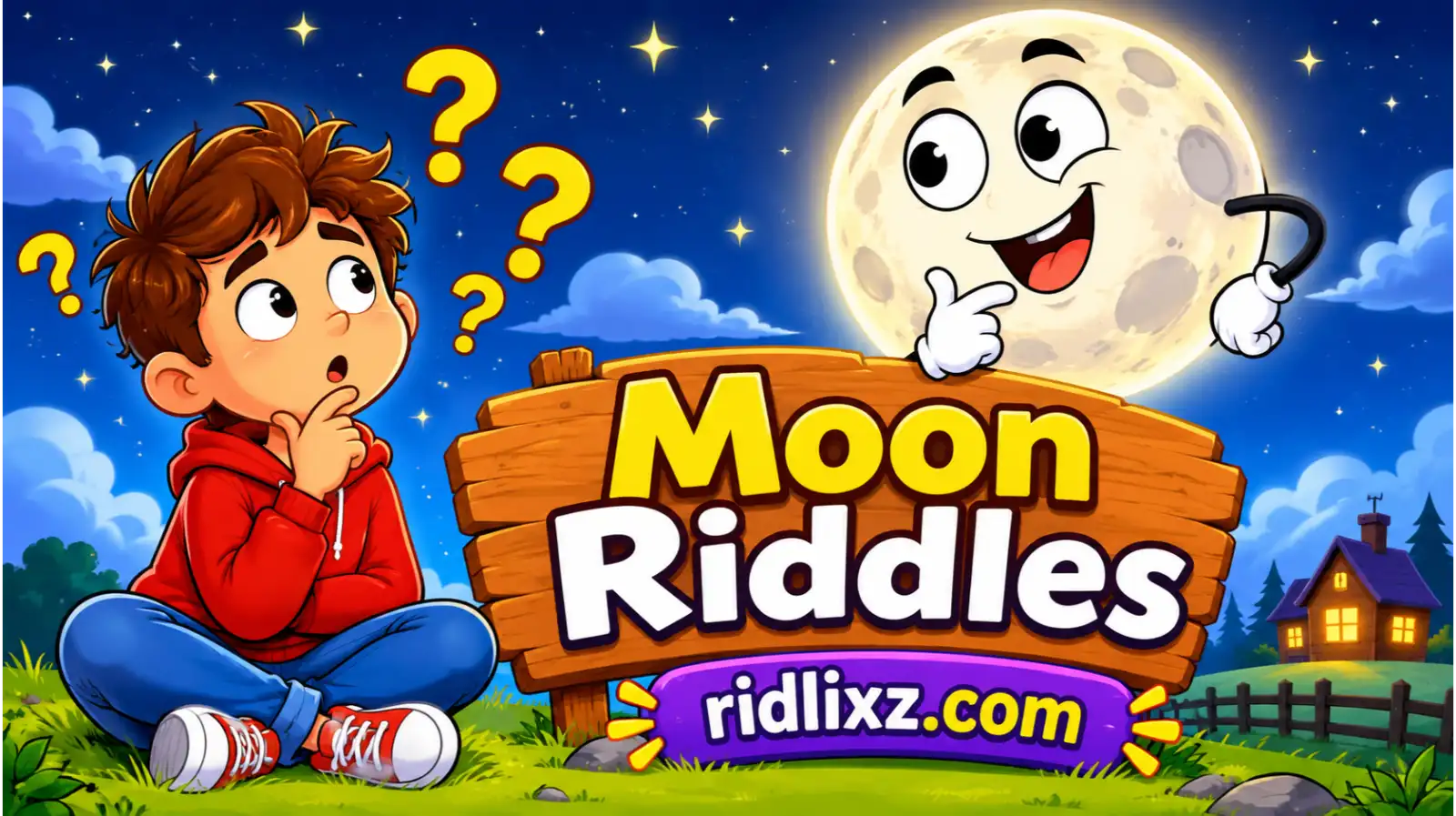
Moon riddles turn the night sky into a playground for curiosity. Whether you’re watching a bright full moon, spotting a thin crescent, or wondering why the Moon seems to follow you on a nighttime walk, there’s plenty of inspiration for clever puzzles. These moon riddles combine astronomy, wordplay, visual clues, and a little misdirection to make guessing fun for readers of all ages.
- Looking for easy lunar puzzles for children? You’ll find simple questions with satisfying answers.
- Want to challenge your friends? Try the tricky riddles that require careful thinking.
- Planning a classroom activity, family game night, or astronomy-themed party? These riddles offer an entertaining way to explore the Moon.
- Love science? Some puzzles touch on lunar phases, moonlight, craters, and the Moon’s journey around Earth.
Every riddle includes its answer, so you can test yourself before checking the solution. Read each clue slowly, picture the scene, and resist the temptation to peek too soon. The next lunar mystery might be easier than it looks—or trickier than you expect!
💡 Did You Know?
- The Moon completes one orbit around Earth in about 27.3 days relative to distant stars.
- The Moon doesn’t produce its own visible light; it reflects sunlight toward Earth.
- The same side of the Moon generally faces Earth because the Moon rotates once on its axis in roughly the same time it takes to orbit Earth.
🎯 Riddle of the Day
– I wear a silver coat borrowed from the Sun,
I change my shape, yet my journey isn’t done.
I travel with Earth through the darkness above,
And inspire countless stories of wonder and love.
What am I?
Guess before revealing the answer!
Answer: The Moon
Easy Moon Riddles for Kids
These beginner-friendly moon riddles use familiar words and simple clues, making them great for young children, parents, and teachers.
– I shine in the sky when the Sun goes away,
But borrowed light is what I display.
Look up at night and you’ll find me soon.
Answer: The Moon
– Sometimes I’m round, sometimes a slice,
My changing appearance looks rather nice.
I visit the night sky month after month.
Answer: The Moon
– I have no mouth, yet people sing to me,
I have no feet, yet I travel endlessly.
Around our planet, I follow my track.
Answer: The Moon
– A giant round lamp that isn’t electric,
My glow in the darkness looks almost poetic.
What shines above without a switch?
Answer: The Moon
– I can look like a banana hanging up high,
But I’m not a fruit floating through the sky.
Find me at night in a curved little view.
Answer: A crescent Moon
– No legs, no wings, yet I cross the night,
Changing my face in the soft starlight.
I circle the world without making a sound.
Answer: The Moon
– Children may point when I appear,
A familiar bright shape in the atmosphere.
What heavenly neighbor is easy to see?
Answer: The Moon
– I’m not made of cheese, though stories pretend,
My rocky landscape has craters that extend.
Which space traveler shines overhead?
Answer: The Moon
– I follow no road, yet circle Earth,
A natural satellite of enormous worth.
Who am I in the midnight blue?
Answer: The Moon
– Sometimes I hide, though I’m still in space,
Clouds or daylight may obscure my face.
What object might you fail to see?
Answer: The Moon
Funny Moon Riddles
Ready for lunar laughs? These moon riddles use silly comparisons and unexpected punchlines to make the night sky a little more entertaining.
– Why did the Moon skip the gym?
It already had plenty of space to move around.
Answer: Because it was already in orbit!
– What does the Moon use to keep its hair in place?
It needs something strong for its cosmic style.
Answer: Space spray!
– Why did the Moon bring a suitcase to Earth?
It wanted to visit without staying forever.
Answer: It was planning a lunar getaway!
– What kind of music does the Moon enjoy?
Something that sounds good among the stars.
Answer: Space rock!
– Why did the Moon refuse to join the choir?
Everyone expected it to sing every night.
Answer: It didn’t want to be a full-time performer!
– What did the Moon say to the Sun at sunset?
It was finally time for a change of scenery.
Answer: “My shift starts now!”
– Why is the Moon terrible at keeping secrets?
People keep looking up and talking about it.
Answer: Because it’s always the center of attention!
– What happens when the Moon tells a joke?
Its audience is spread across the planet.
Answer: The whole world might get a little space humor!
– Why did the Moon take a notebook to space?
It didn’t want to forget its bright ideas.
Answer: To keep track of its lunar thoughts!
– Why did the Moon get invited to every costume party?
It can look different from one appearance to the next.
Answer: It always has a new phase!
Tricky Moon Riddles for Adults
These puzzles rely on careful wording, observation, and a little lateral thinking. Try solving each one without immediately jumping to the most obvious answer.
– I grow thinner without losing any rock,
Then grow fuller as days pass on the clock.
What changes while my body stays whole?
Answer: The Moon’s visible phase
– I can be seen in daylight, though night is my fame,
And the shape that you notice is never quite the same.
What am I?
Answer: The Moon
– I pull at the oceans without touching a shore,
My gravity helps make the tides rise and fall.
Which celestial neighbor plays this role?
Answer: The Moon
– I circle a planet but am not a star,
I have no atmosphere like Earth’s from afar.
What kind of object am I?
Answer: Earth’s natural satellite
– My face has dark patches that look like a sea,
Yet water-filled oceans aren’t what you’ll see.
What are these broad, dark plains called?
Answer: Lunar maria
– I can disappear from view without going away,
My position and the Sun decide what you see each day.
What explains my changing appearance?
Answer: The Moon’s phases
– I make no light, but I brighten the ground,
When sunlight reflects, my glow can be found.
What am I?
Answer: The Moon
– I am tidally locked, so one side you mostly see,
The other side isn’t always hidden from the Sun, you see.
What celestial body am I?
Answer: The Moon
– My craters tell stories of impacts long past,
With little weather to erase them fast.
Where would you find these ancient marks?
Answer: The lunar surface
– I seem to chase you as you travel by car,
Yet my distance makes me look fixed from afar.
Why do I appear to follow you?
Answer: The Moon is so distant that its position changes very little from your perspective during a short journey.
Moon Riddles With One-Word Answers
Quick riddles are ideal for quizzes, short videos, classroom warm-ups, or a friendly guessing competition.
– A bright circle in the night, reflecting sunlight. What is it?
Answer: Moon
– A thin curved shape seen during part of the lunar cycle. What is it?
Answer: Crescent
– A rocky bowl made by an impact on the lunar surface. What is it?
Answer: Crater
– The phase when the Moon’s visible face looks fully illuminated. What is it?
Answer: Full moon
– The phase when the Moon appears mostly dark from Earth. What is it?
Answer: New moon
– The natural satellite that orbits Earth. What is it?
Answer: Moon
– The force that helps keep the Moon in orbit around Earth. What is it?
Answer: Gravity
– A large, dark plain on the Moon, named using a word meaning sea. What is it?
Answer: Mare
– The event when Earth’s shadow falls on the Moon. What is it?
Answer: Lunar eclipse
– The path a celestial body follows around another body. What is it?
Answer: Orbit
Moon Phase Riddles
The Moon’s changing appearance provides plenty of inspiration for puzzles. These riddles explore the different phases seen from Earth.
– I look like a glowing dinner plate,
With no dark edge to dominate.
Which phase am I?
Answer: Full moon
– I’m a narrow smile in the evening sky,
A little curved light floating high.
Which phase am I?
Answer: Waxing crescent
– I appear to grow from night to night,
As more of my visible face catches light.
What am I doing?
Answer: Waxing
– My bright portion shrinks day by day,
Until less of my lit face is on display.
What am I doing?
Answer: Waning
– Half my visible disk looks bright,
Half appears dark to your sight.
Which phase might this describe?
Answer: A quarter Moon
– I’m more than half lit, but not yet full,
A growing bright shape that’s beautiful.
What phase am I?
Answer: Waxing gibbous
– I’m more than half lit, but my light is decreasing,
As the bright portion slowly keeps receding.
What phase am I?
Answer: Waning gibbous
– I seem to vanish from the nighttime view,
Though my journey around Earth continues through.
Which phase am I?
Answer: New moon
– I come after the full Moon’s glow,
With less illuminated surface to show.
What phase follows as the light decreases?
Answer: Waning gibbous
– My cycle repeats, though each night may look new,
As sunlight and viewing angles change your view.
What am I describing?
Answer: The lunar phases
Moon and Space Riddles
Travel beyond ordinary night-sky observations with these riddles about lunar geography, space travel, and the Moon’s relationship with Earth.
– I am a visitor from Earth, built to cross space,
I carry explorers toward a dusty place.
What vehicle might take astronauts there?
Answer: A spacecraft
– I am the dusty ground beneath an astronaut’s feet,
With countless old craters and no forests to greet.
What surface am I?
Answer: The lunar surface
– I circle Earth but never need a road,
Gravity keeps me on my cosmic mode.
What path describes my journey?
Answer: An orbit
– I am Earth’s companion, rocky and round,
With no living forests or oceans around.
What am I?
Answer: The Moon
– My surface is marked by ancient scars,
Created by impacts from objects in space.
What are these marks called?
Answer: Craters
– I can block sunlight from reaching Earth,
Casting a moving shadow of great worth.
What event am I describing?
Answer: A solar eclipse
– Earth stands between the Sun and me,
And Earth’s shadow changes what you see.
What event is this?
Answer: A lunar eclipse
– I am a space traveler designed for a human crew,
Helping astronauts explore beyond Earth’s view.
What am I?
Answer: A crewed spacecraft
– I am a broad, dark region that early observers mistook for a sea,
Though solid rock is what you’ll find in me.
What am I?
Answer: A lunar mare
– I don’t have Earth’s thick blanket of air,
So footsteps and footprints can linger there.
Where might you find them?
Answer: On the Moon
Moonlight and Night Sky Riddles
These riddles focus on the Moon’s glow, its place in the night sky, and the way we observe it from Earth.
– I paint rooftops silver without a brush,
And make a quiet garden glow without a rush.
What light am I?
Answer: Moonlight
– I share the sky with stars at night,
Sometimes appearing as a narrow light.
What am I?
Answer: The Moon
– I can look orange near the horizon,
Though my actual color hasn’t suddenly changed.
What am I?
Answer: The Moon
– I am the dark space behind the lunar glow,
Where countless distant stars may show.
What am I?
Answer: The night sky
– I can hide the Moon with a passing veil,
Bringing clouds that cover the sky’s pale trail.
What am I?
Answer: A cloud
– I help you see the Moon more clearly,
By gathering light from far away.
What instrument am I?
Answer: A telescope
– I sparkle far away, while the Moon looks near,
A vast universe surrounds us here.
What am I?
Answer: A star
– I appear when the Moon blocks the Sun,
A darkened daytime spectacle for everyone.
What am I?
Answer: A solar eclipse
– I borrow sunlight and send it your way,
Making the darkness less dark than it may.
What am I?
Answer: The Moon
– I can make a shadow on the ground at night,
When the Moon is bright enough to provide light.
What causes this shadow?
Answer: Moonlight
Hard Moon Riddles for Puzzle Lovers
Think carefully before reading the answers. These challenging moon riddles use scientific ideas and less obvious clues.
– I always show Earth nearly the same face,
Yet I rotate while moving through space.
What motion explains this familiar view?
Answer: Synchronous rotation, also called tidal locking
– My orbit takes longer than my spin?
Not in the usual way observers might think.
One rotation and one orbit take nearly equal time.
What am I?
Answer: The Moon
– I am not a planet, not a star,
Yet I influence tides from afar.
What celestial object am I?
Answer: Earth’s natural satellite
– When I stand opposite the Sun in Earth’s sky,
My fully lit face can catch your eye.
Which phase is likely visible?
Answer: Full moon
– When my path takes me through Earth’s shadow,
My brightness may change as the shadow grows.
What event is happening?
Answer: A lunar eclipse
– The Sun lights half of me at any time,
But from Earth, the visible portion changes with time.
What explains the changing bright shape?
Answer: The relative positions of the Sun, Earth, and Moon
– I look like a world with seas but no waves,
And ancient impacts are the marks I save.
What are the dark plains called?
Answer: Lunar maria
– I pull Earth’s water, but I’m not a hand,
My gravitational influence reaches across the land.
What force am I using?
Answer: Gravity
– I am the average time between two matching lunar phases,
Lasting about 29.5 days through the Moon’s changing faces.
What cycle am I?
Answer: The synodic month
– I may appear enormous when low in the sky,
Though measurements show no sudden change in size.
What common effect is this?
Answer: The Moon illusion
Moon Riddles for School and Classroom Activities
Teachers and parents can use these puzzles to spark conversations about astronomy, reading comprehension, and scientific observation.
– I am a natural object that circles a planet,
Unlike a human-made satellite sent into orbit.
What am I?
Answer: A natural satellite
– I help create tides along many coasts,
Through gravitational influence rather than oceanic motion of my own.
What am I?
Answer: The Moon
– I have no breathable atmosphere like Earth,
Yet astronauts have walked upon my surface.
Where am I?
Answer: The Moon
– My phases repeat in a familiar pattern,
Though I do not physically change shape.
What causes the pattern?
Answer: Changing viewing angles as the Moon orbits Earth
– I look dark during a solar eclipse,
When I pass between Earth and the Sun.
What am I?
Answer: The Moon
– I am a mark left by a collision,
A circular feature on the lunar surface.
What am I?
Answer: A crater
– I am the Sun’s light bouncing from a surface,
Making the Moon visible from Earth.
What am I?
Answer: Reflected sunlight
– I am the phase that appears after the new Moon,
As a thin bright curve begins to show.
What am I?
Answer: Waxing crescent
– I am a device that helps scientists observe distant objects,
Gathering light to reveal details in space.
What am I?
Answer: A telescope
– I am Earth’s closest natural celestial neighbor,
A world of rock that astronauts have explored.
What am I?
Answer: The Moon
Short Moon Riddles for Social Media
These compact riddles are easy to share in messages, posts, or quick guessing games. Ask your audience to comment with an answer before revealing the solution.
– A silver face that borrows light. What am I?
Answer: The Moon
– No wings, yet I circle Earth. What am I?
Answer: The Moon
– A rocky world with countless scars. What am I?
Answer: The Moon
– Sometimes full, sometimes thin. What changes?
Answer: The Moon’s phase
– Earth’s companion with no roads to roam. What am I?
Answer: The Moon
– I help move the oceans without touching the shore. What am I?
Answer: The Moon’s gravity
– A shadow across the Sun turns day strange. What am I?
Answer: A solar eclipse
– Earth’s shadow makes my bright face dim. What am I?
Answer: A lunar eclipse
– A glowing curve that looks like a smile. What am I?
Answer: A crescent Moon
– I shine at night but make no light. What am I?
Answer: The Moon
Bonus Moon Riddles With Clever Wordplay
These final puzzles mix lunar imagery with playful language. Some answers are scientific terms, while others rely on familiar expressions.
– Why does the Moon make a good travel companion?
It always knows how to stay on course.
Answer: It follows its orbit!
– What do you call the Moon when it tells a fantastic story?
A tale with a little cosmic sparkle.
Answer: A lunar legend!
– Why did the Moon get a job in photography?
It was excellent at working with light.
Answer: It had a bright future!
– What is the Moon’s favorite kind of geometry?
Shapes that change as the month goes on.
Answer: Lunar phases!
– Why did the Moon bring a map to its meeting?
It wanted to stay on the right path.
Answer: To keep its orbit in mind!
– What do you call a Moon that loves jokes?
A celestial comedian with a dry sense of humor.
Answer: A funny Moon!
– Why is the Moon never truly alone?
It travels with a planetary companion.
Answer: Earth is always nearby!
– What is the Moon’s favorite kind of book?
One full of stars, strange worlds, and distant journeys.
Answer: A space adventure!
– Why did the Moon get praised for its performance?
Its appearance kept changing at just the right time.
Answer: It was in all the right phases!
– What do you call the Moon’s quiet evening glow?
A soft light borrowed from the Sun.
Answer: Moonlight!
Tips for Using Moon Riddles
Make these puzzles even more enjoyable with a few simple activities:
- For kids: Read one clue aloud and let children draw what they imagine before revealing the answer.
- For classrooms: Pair the riddles with pictures of lunar phases or a lesson about Earth’s natural satellite.
- For family game nights: Take turns reading clues and award a point for each correct answer.
- For social media: Post the riddle first and share the answer in a later comment to encourage guesses.
- For astronomy clubs: Mix the easy puzzles with the harder science-based questions to suit different knowledge levels.
- For parties: Put individual riddles on slips of paper and let guests draw one from a bowl.
FAQs:
What are moon riddles?
Moon riddles are puzzles about the Moon, lunar phases, moonlight, space, and related ideas that challenge readers to solve a clue.
Are moon riddles suitable for kids?
Yes, easy moon riddles with clear clues and simple answers are suitable for children and can introduce basic astronomy concepts.
What is a good moon riddle for beginners?
“I shine at night but make no light; sunlight reflects to give me sight. What am I?” The answer is the Moon.
How can I make moon riddles harder?
Use clues involving lunar eclipses, synchronous rotation, gravity, and the difference between the lunar cycle and the Moon’s orbital period.
Can moon riddles be used in the classroom?
Yes, teachers can use them as warm-ups, science review questions, group competitions, or activities about the night sky.
Why does the Moon appear to change shape?
The Moon’s shape appears to change because we see different portions of its sunlit half as it orbits Earth.
Conclusion:
Moon riddles offer a fun way to explore the night sky while exercising your imagination and problem-solving skills. From easy puzzles for kids to challenging lunar brainteasers for adults, there’s something here for family game nights, classrooms, astronomy activities, and social media challenges. You can even use the science-based riddles to start a conversation about the Moon’s phases, craters, and relationship with Earth.
– Which moon riddle was your favorite? Share it with a friend, challenge someone to solve the hardest puzzle, or save this collection for your next stargazing night. The next time you look up at the Moon, you might see more than just a glowing circle—you might see your next great riddle.
Is this conversation helpful so far?

2 thoughts on “117+ Moon Riddles Fun, Tricky, and Clever Puzzles”