
Ancient riddles offer a fascinating way to explore the mysteries of the past while giving your brain a satisfying workout. From the monumental pyramids of Egypt to the legendary temples of Greece, ancient civilizations left behind stories, symbols, and questions that continue to spark curiosity. Their worlds were filled with mysterious inscriptions, powerful rulers, clever inventors, and myths that challenged people to think beyond the obvious.
This collection of ancient riddles brings that spirit of discovery to readers of all ages. You’ll find original puzzles inspired by ancient architecture, Egyptian treasures, Greek mythology, Roman life, forgotten kingdoms, and the everyday objects that helped shape early civilizations. Some riddles are easy enough for kids to solve, while others require patience, lateral thinking, and a little imagination.
Each puzzle comes with its answer, so you can test yourself before checking the solution or use the collection for family game nights, classroom activities, history lessons, and friendly competitions.
Ready to unlock the secrets of the ancient world? Read each riddle carefully, look beyond the obvious clues, and see how many mysteries you can solve.
💡 Did You Know?
- Riddles appear in ancient literature. The Riddle of the Sphinx is a famous episode in Greek mythology in which Oedipus solves a question about the stages of human life.
- Ancient Egyptian writing used pictures and signs. Egyptian hieroglyphs could represent sounds, words, or ideas, making them a fascinating subject for anyone who enjoys deciphering clues.
- Wisdom literature included puzzles and questions. Across different cultures, questions, proverbs, and wordplay helped people explore knowledge, judgment, and human behavior.
Historical note: The puzzles below are newly written and inspired by ancient settings. They are not presented as authentic translations of riddles discovered on ancient tablets or inscriptions.
🎯 Riddle of the Day
- I stand beneath the desert sun,
My sides meet high where lines become one.
A king may rest within my stone,
Yet centuries pass while I stand alone.
What am I?Answer: An Egyptian pyramid.
Ancient Riddles About Egypt and the Pharaohs
The ancient Egyptian world was filled with royal monuments, sacred symbols, elaborate tombs, and remarkable craftsmanship. These original puzzles explore that world through familiar objects and historical imagery.
- Silent guardians with bodies of stone,
I watch the desert without moving alone.
My face is carved, my gaze looks wide.
What ancient wonder am I beside?Answer: A sphinx statue. - Gold rests upon a ruler’s head,
A symbol of power among the dead.
Though shaped for kings in ages gone,
My shining metal still carries on.
What am I?Answer: A royal crown. - Inside the tomb, I wait in the gloom,
Protecting a body within my room.
My carved stone face may bear a name,
While generations forget my fame.
What am I?Answer: A sarcophagus. - Along the Nile, I rise and fall,
Bringing rich soil to fields for all.
Farmers welcome what I leave behind;
Without my gifts, their crops would decline.
What am I?Answer: The Nile’s seasonal flood. - My painted walls hold scenes of old,
With gods and kings in red and gold.
Behind my doorway, secrets sleep,
While ancient stories my chambers keep.
What am I?Answer: An Egyptian tomb. - I have no voice, yet names I preserve,
Through carved signs and careful curves.
Scholars study my marks with care,
To learn what ancient writers shared.
What am I?Answer: A hieroglyphic inscription. - A river’s gift, a scribe’s delight,
I turn black beneath a writing tool’s bite.
Made from a plant that grows near the stream,
I carry records, accounts, and dreams.
What am I?Answer: Papyrus. - My body is wrapped from head to toe,
Prepared with care long ago.
In ancient Egypt, I was made to stay,
As people hoped life would continue beyond today.
What am I?Answer: A mummy. - A tiny charm with a mighty role,
I offer protection, so people hoped of old.
Worn close to the body or placed in a tomb,
I bring symbolic meaning to a sacred room.
What am I?Answer: An amulet. - A royal name within an oval frame,
Carved into stone to honor its fame.
Find me on monuments built long ago;
Which Egyptian royal name-mark do I show?Answer: A cartouche.
Ancient Greek Riddles Inspired by Gods and Legends
Greek mythology is full of clever heroes, strange creatures, difficult choices, and supernatural challenges. These riddles draw inspiration from its legendary characters and symbols without claiming to reproduce ancient Greek texts.
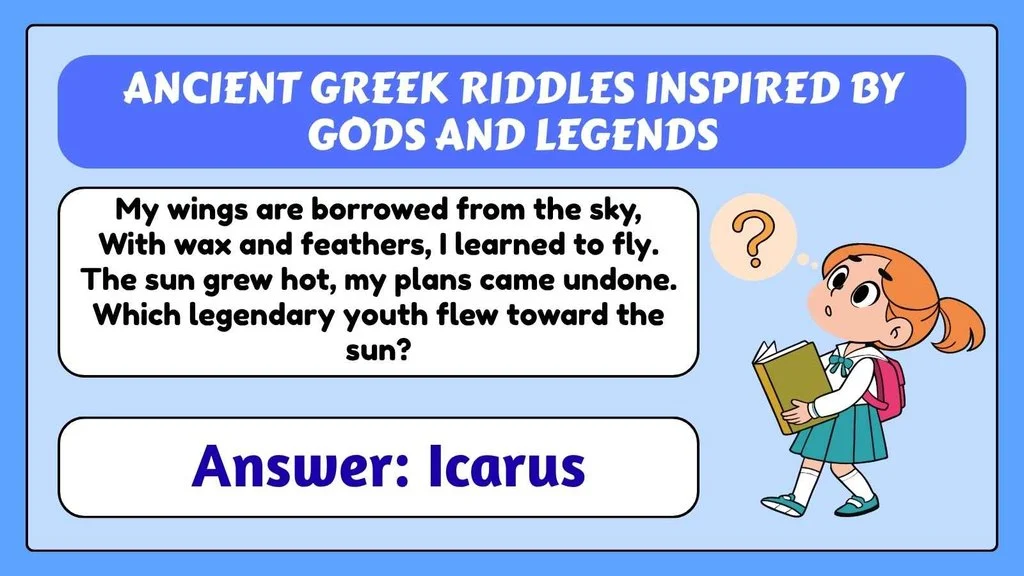
- My wings are borrowed from the sky,
With wax and feathers, I learned to fly.
The sun grew hot, my plans came undone.
Which legendary youth flew toward the sun?Answer: Icarus. - I guarded a road with a question to share,
Travelers stopped when they met my stare.
One clever answer ended my reign.
Which mythical creature was defeated by a brain?Answer: The Sphinx. - My hair once crowned a mortal head,
Then writhing serpents took its place instead.
One look from me could turn flesh to stone.
Which Gorgon made this power her own?Answer: Medusa. - A thread led the way through a twisting maze,
Helping a hero escape its confusing ways.
A beast was defeated deep inside.
Which Greek hero took that dangerous ride?Answer: Theseus. - With many heads, I made danger grow;
Cut one away, and more could show.
A mighty hero found a way to win.
Which monster lived in the marshy din?Answer: The Hydra. - From foam and sea, my beauty arose,
Admired by gods wherever I chose.
Love and desire became my domain.
Which Greek goddess bore this fame?Answer: Aphrodite. - My three heads bark at the gate below,
Where departed souls are said to go.
A hero once passed my fearsome face.
Which guardian watched the underworld’s place?Answer: Cerberus. - A bow in my hand, wild forests my home,
Through moonlit paths I freely roam.
Hunting and wilderness are my art.
Which goddess plays this ancient part?Answer: Artemis. - I carry a thunderbolt, ruling from above,
King of the gods in myths people love.
Mount Olympus is my celebrated throne.
Which Greek god claims the skies as his own?Answer: Zeus. - A wooden horse concealed a dangerous plan,
Helping Greek warriors enter a city of man.
Its gift looked harmless until night fell.
Which famous war does this story tell?Answer: The Trojan War.
Roman Riddles About Empire and Everyday Life
Ancient Rome combined military power, impressive engineering, busy marketplaces, and public entertainment. These puzzles explore objects and places associated with Roman society.
- I carry water without a bucket or pail,
Across the countryside, I form a stone trail.
My arches help the precious flow;
What Roman structure am I, built long ago?Answer: An aqueduct. - Crowds once gathered beneath my great roof,
To watch public contests and feats of proof.
My stone seats held thousands in view.
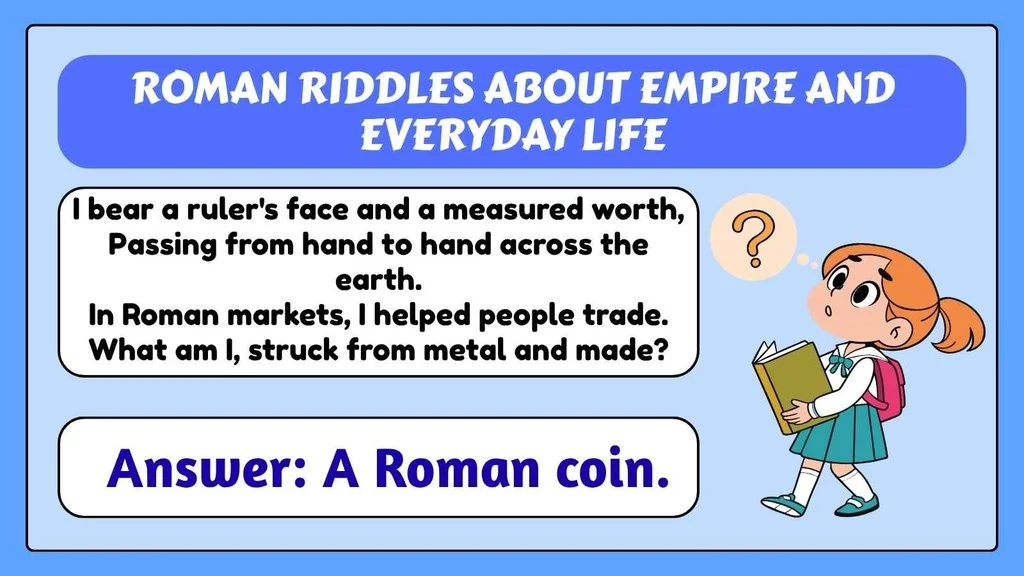
Which Roman landmark am I to you?Answer: The Colosseum. - I bear a ruler’s face and a measured worth,
Passing from hand to hand across the earth.
In Roman markets, I helped people trade.
What am I, struck from metal and made?c - A soldier may carry me into a fight,
I protect the body from a blade’s sharp bite.
Metal or leather may cover my frame.
What piece of Roman equipment earns its name?Answer: Armor. - Four letters can make a century’s mark,
Etched on stone or raised in a public park.
My signs can stand for numbers in a row.
Which Roman system helps you count what you know?Answer: Roman numerals. - I stretch through lands with a durable face,
Helping armies and merchants travel from place to place.
Stones beneath feet guide journeys afar.
What Roman achievement am I, built to connect and carry?Answer: A Roman road. - A public square where citizens meet,
With merchants, speakers, and footsteps in the street.
Roman business and politics gathered there.
What central place did many people share?Answer: The Roman forum. - I am a curved roof built without timber beams,
An engineering wonder from architectural dreams.
My shape spreads weight with remarkable grace.
What structure gives large rooms a rounded space?Answer: An arch or vaulted structure. - I travel on land with a wheel at each side,
Pulled by horses on roads far and wide.
Roman travelers used me to carry their load.
What am I, moving along an ancient road?Answer: A horse-drawn cart. - A short blade, a shield, and a soldier’s training,
I appear in arenas where crowds were remaining.
Some fought for survival, fame, or show.
Which Roman fighter did spectators know?Answer: A gladiator.
Ancient Riddles About Temples and Sacred Places
Temples and sacred spaces served different religious and civic purposes across the ancient world. These riddles focus on architecture, rituals, and the objects that made such places distinctive.
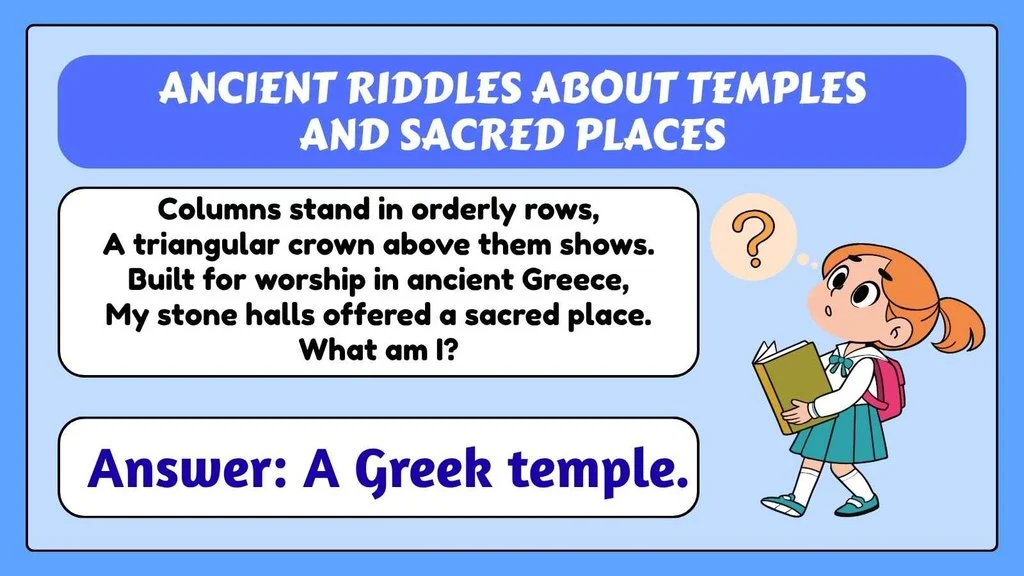
- Columns stand in orderly rows,
A triangular crown above them shows.
Built for worship in ancient Greece,
My stone halls offered a sacred place.
What am I?Answer: A Greek temple. - I rise above the city on a hill,
With sacred buildings standing still.
Athens is famous for the heights I crown.
What ancient landmark overlooks the town?Answer: The Acropolis. - I carry a flame through ritual and prayer,
Placed in a sacred space with care.
Though I have no feet, I stand in a bowl.
What keeps the ceremonial fire whole?Answer: A sacred brazier. - Incense curls upward into the air,
As offerings are presented with care.
I hold the gift before the divine.
What sacred object marks the ritual line?Answer: An altar. - My steps are worn by countless feet,
Leading worshippers to a place they meet.
I have no door, yet I guide the way.
What part of a temple do I display?Answer: A temple staircase. - Beneath the earth, I shelter a spring,
Where sacred stories give water meaning.
People may visit to pray or give thanks.
What ancient holy place could hold such a chance?Answer: A sacred well or spring. - A carved stone stands upright and tall,
Recording a ruler, a law, or a call.
My message survives long after the hand.
What monument helps old words still stand?Answer: A stone stele. - My roof is supported by pillars of stone,
My walls hold images of gods once known.
Travelers may pause in my shadowed hall.
What sacred building welcomes them all?Answer: A sanctuary. - I mark a boundary no foot should cross,
A sacred line with symbolic cost.
My meaning depends on custom and place.
What do I define in a holy space?Answer: A ritual boundary. - I am a vessel used in offerings made,
Sometimes of clay, sometimes finely laid.
I may hold water, oil, or grain.
What ancient ritual object bears the strain?Answer: A ceremonial vessel.
Ancient Riddles About Archaeology and Lost Civilizations
Archaeologists study physical evidence to understand past human life. A broken object or buried wall can reveal clues that written records never preserved.
- I lie beneath soil, unseen for years,
Until a careful brush removes my layers.
I may be pottery, a tool, or bone.
What ancient clue has the earth made its own?Answer: An archaeological artifact. - My broken pieces once formed a whole,
Now patient hands give me back my role.
Each shard provides a little more.
What do archaeologists try to restore?Answer: A broken artifact or pottery vessel. - I am a mark pressed into wet clay,
Preserving a message from a distant day.
My tiny signs once helped records endure.
What ancient writing surface could be so secure?Answer: A clay tablet. - No living builder remembers my name,
Yet stones reveal where people became.
Digging and study expose my past.
What buried settlement emerges at last?Answer: An archaeological site. - A layer of soil rests over another,
Each one preserving clues from a different era.
Read them carefully, and time becomes clear.
What geological record do archaeologists use here?Answer: Stratigraphy. - My surface bears scratches arranged in rows,
A language forgotten that no one now knows.
Scholars compare me with signs they can read.
What ancient puzzle might I help them decipher indeed?Answer: An undeciphered inscription. - I once held grain, oil, or wine,
In a busy household or trading line.
My handles may break, but my shape remains.
What ancient storage vessel survives in grains?Answer: An amphora. - I am a wall with no living guard,
Built to protect a settlement’s yard.
My gates once controlled who came through.
What ancient defense stood around a city or two?Answer: A city wall. - My layers record where people stayed,
What they ate, built, traded, and made.
Long after homes have disappeared,
My buried remains keep evidence clear.
What am I?Answer: An archaeological settlement deposit. - I show the outline of a life long past,
In a cave or grave where time has cast
A shape that tells what once was there.
What preserved remains might researchers carefully compare?Answer: Fossilized or preserved remains, depending on the context.
Ancient Riddles About Tools, Inventions, and Technology
Ancient communities developed practical tools for farming, building, writing, measuring, and traveling. These puzzles celebrate the ingenuity behind everyday inventions.
- My teeth bite wood but never chew,
A carpenter guides me straight and true.
Push me back and forth to make a line.
What ancient workshop tool is mine?Answer: A saw. - Two arms meet at a single point,
Their turning motion helps things join.
I can grip or cut depending on my design.
What tool makes metalwork easier in time?Answer: Pliers. - I help lift loads that hands cannot raise,
With a rope and wheel, I simplify days.
Builders use my turning power with care.
What simple machine can lift a heavy share?Answer: A pulley. - A pointed tip leaves marks behind,
On wax or clay, a message you’ll find.
Before modern pens became the norm,
What writing implement took an ancient form?Answer: A stylus. - I turn with the wind or the pull of a beast,
Grinding grain into flour for a feast.
My stones work steadily round and round.
What ancient machine makes meal from what is ground?Answer: A millstone. - A curved blade cuts the harvest down,
Helping farmers gather crops from the ground.
Its handle fits the worker’s hand.
What ancient farming tool serves the land?Answer: A sickle. - I guide a builder’s line so walls stay straight,
Helping stones align at the proper rate.
My simple form brings order to a place.
What measuring tool helps establish a base?Answer: A plumb line. - My wheels turn beneath a load,
Carrying goods along a dusty road.
Strong animals pull me where travelers go.
What useful vehicle moves goods to and fro?Answer: A wagon. - I measure the passing of a day,
By watching sunlight move its way.
A shadow shifts as hours pass.
What ancient timekeeper stands in the grass?Answer: A sundial. - I use a lever, a pivot, and a steady hand,
To raise a weight that would otherwise stand.
Change where the force is applied, and you’ll see
How simple mechanics work with me.
What machine am I?Answer: A lever.
Ancient Riddles About Writing, Books, and Secret Messages
Writing allowed ancient societies to record laws, trade, stories, and religious traditions. These riddles explore the materials and methods used to preserve knowledge.
- I am made of many pages bound as one,
Holding words that outlast the sun.
Though modern books have changed my style,
Ancient scrolls once filled a similar role for a while.
What am I?Answer: A book or manuscript collection. - Roll me open to read what I contain,
Then roll me closed to protect me again.
My written lines may tell of a king.
What ancient format preserves such a thing?Answer: A scroll. - I am pressed into clay, one sign at a time,
My wedge-shaped marks form a written line.
Mesopotamian scribes used me to record their lore.
What writing system appeared on tablets of yore?Answer: Cuneiform. - I have no sound, yet I can speak,
When a reader finds the words they seek.
My marks remain when voices depart.
What gives written language its enduring art?Answer: An inscription or written text. - A secret message hides in a changed design,
Where letters stand in another line.
Only the right key reveals what is true.
What method keeps a written message from view?Answer: A cipher. - I am a symbol with a sound,
One small part of words written down.
Join me with others, and language takes flight.
What written unit makes reading possible outright?Answer: A letter. - My surface once held records of grain,
Of taxes, shipments, and royal domain.
Clay could preserve me when paper was rare.
What practical record might a scribe prepare?Answer: An administrative tablet. - I am a picture that stands for a word,
Or sometimes a concept readers have heard.
Ancient signs can carry meaning in this way.
What kind of symbol might a scribe display?Answer: A pictogram. - My words describe a law for all to see,
Carved in stone for public memory.
Rulers used such displays to make rules known.
What written monument might be shown?Answer: A law stele. - My pages may be gone, but my story remains,
In fragments, quotations, and scholars’ gains.
I carried knowledge from one age to another.
What ancient work might survive through copies of another?Answer: A surviving ancient text.
Ancient Riddles About Astronomy, Time, and the Sky
Observing the heavens helped ancient societies track seasons, plan agricultural work, and develop calendars. These original puzzles draw on the Sun, Moon, stars, and the passage of time.
- I rise without climbing a hill,
And set when the western sky grows still.
My light marks the beginning of day.
What heavenly body lights your way?Answer: The Sun. - I change my shape from night to night,
Yet keep returning with borrowed light.
Sometimes a crescent, sometimes round,
What celestial neighbor circles around?Answer: The Moon. - I appear as a pattern in the dark,
A guide for travelers who watch my spark.
Though each point is distant and bright,
Together I form a familiar sight.
What am I?Answer: A constellation. - Twelve named divisions may mark the year,
As seasons change and harvests draw near.
Ancient calendars watched the sky with care.
What system helps organize time through the year?Answer: A calendar. - I measure time with sand that flows,
From the upper chamber to the one below.
Turn me over to begin once more.
What simple timer stands on the floor?Answer: An hourglass. - At midday, I shorten on the ground,
At sunrise and sunset, long shapes are found.
I follow the Sun without a sound.
What dark outline stretches around?Answer: A shadow. - My name suggests a journey across the sky,
Though I am a pattern you can identify.
I may help mark a season’s return.
What group of stars might ancient observers learn?Answer: A constellation. - I vanish by day in the bright blue light,
Yet return to the heavens at night.
I am not a planet, though I seem to gleam.
What distant object completes this scene?Answer: A star. - I am the path the Earth takes around the Sun,
A yearly journey that is never done.
My shape is not a perfect ring.
What orbital route describes this thing?Answer: Earth’s orbit. - A rare dark moment interrupts the glow,
When one heavenly body blocks another’s show.
The Sun or Moon may seem to disappear.
What astronomical event has occurred here?Answer: An eclipse.
Ancient Riddles About Nature and the Elements
Ancient people observed the natural world closely, from storms and rivers to mountains and fertile soil. These puzzles focus on the elements and natural features that shaped human life.
- I roar without a mouth,
And race from north to south.
I bend the trees and stir the sea.
What invisible force could I be?Answer: The wind. - I fall from clouds but have no feet,
I feed the fields and cool the heat.
I gather in rivers and oceans wide.
What natural gift comes from the sky?Answer: Rain. - My peak may wear a snowy crown,
My rocky sides reach valleys down.
Climbers test their strength on me.
What landform rises for all to see?Answer: A mountain. - I hold the heat beneath the ground,
Then send molten rock where openings are found.
When I erupt, ash fills the air.
What powerful landform should people beware?Answer: A volcano. - I begin as a trickle, then travel along,
Through fields and valleys, steady and strong.
I carry fresh water toward the sea.
What flowing body might I be?Answer: A river. - I cover the earth with a blanket of green,
Where countless roots and small lives are seen.
Trees rise above me, and wild creatures roam.
What natural habitat do many call home?Answer: A forest. - I am born when clouds gather and light flashes bright,
A sudden loud crack can follow my flight.
I travel through air but leave no trail.
What stormy sound can make windows quail?Answer: Thunder. - Beneath the fields, I cradle seeds,
Giving plants the support they need.
My colors and textures vary from place to place.
What natural material feeds the growing race?Answer: Soil. - I stretch beyond the shore, deep and blue,
With tides and currents that constantly move.
Ships cross my surface, while life fills my deep.
What vast body of salt water do I keep?Answer: The ocean. - I appear when sunlight meets water in the air,
A band of colors floating there.
My curved shape may fade from view.
What colorful arc appears after rain showers through?Answer: A rainbow.
Ancient Riddles About Kings, Queens, and Warriors
Royal courts and military life shaped many ancient societies. These riddles explore leadership, protection, battle equipment, and the symbols of authority.
- A circle of metal sits above the brow,
A sign of authority then and now.
It may be gold, silver, or jeweled with care.
What royal symbol might a ruler wear?Answer: A crown. - I carry no sword, yet command the land,
With laws and decisions made by my hand.
My title may change from kingdom to state.
What leader holds a royal fate?Answer: A king. - I am a ruler whose name may be carved,
On monuments built by workers who labored.
My kingdom may flourish, my armies may roam.
What ancient title means a sovereign’s home?Answer: A pharaoh. - My curved edge flashes when battles begin,
A warrior grips me to protect their skin.
Forged from metal and shaped for the hand,
What weapon once served across many a land?Answer: A sword. - I cover the head when danger draws near,
Offering protection for a soldier’s ear.
Bronze, iron, or leather might form my shell.
What piece of armor can you tell?Answer: A helmet. - I fly above armies, showing a sign,
A symbol that helps keep ranks in line.
Carried in battle, I mark a group.
What cloth on a pole might gather a troop?Answer: A battle standard or flag. - My walls surround a royal place,
Where guards and officials keep their space.
My gates may open for guests or close for war.
What fortified home protects those of power?Answer: A fortress or citadel. - I deliver a ruler’s command,
Carrying words across distant land.
Without a phone or modern train,
What ancient messenger traveled through sun and rain?Answer: A royal courier. - My shield is round, my grip held tight,
I turn aside a weapon’s bite.
Carried by warriors in many a fight,
What protective gear stands before the knight?Answer: A shield. - I decide disputes and judge what is fair,
My rulings may shape how people live there.
In ancient cities, my authority could be great.
What official helps determine a legal fate?Answer: A judge.
Ancient Riddles About Markets, Trade, and Daily Life
Ancient life involved much more than kings and monuments. Farmers, merchants, craftspeople, and families depended on trade, food, household objects, and practical skills.
- I balance two pans on either side,
Helping merchants measure what buyers provide.
Weights make the judgment fair.
What market tool compares goods with care?Answer: A balance scale. - I hold grain or oil within my sides,
And travel with merchants on their rides.
My handles help me move from place to place.
What storage vessel has this useful shape?Answer: A jar. - I turn raw wool into thread,
With patient hands, my work is spread.
Fibers twist into something fine.
What simple tool helps make the line?Answer: A spindle. - A farmer guides me through the field,
Breaking the earth so crops may yield.
Pulled by an animal, I prepare the land.
What farming implement follows the hand?Answer: A plow. - I grind seeds into a powdery meal,
With rotating stones that steadily wheel.
Bread begins with my humble art.
What tool gives flour its start?Answer: A grain mill. - I am a vessel for water or wine,
Poured at a meal when people dine.
My shape may be simple or finely made.
What drinking container could fill this trade?Answer: A cup or drinking vessel. - I am a woven covering spread on the ground,
Where goods for sale may be laid around.
Merchants gather in a busy place.
What market setting brings buyers face to face?Answer: A market stall. - I travel across deserts, carrying goods,
Through heat and sand and rocky woods.
My long-legged stride helps me endure.
What animal was prized for journeys so long and pure?Answer: A camel. - I am a small metal piece exchanged for a good,
Used where barter once commonly stood.
My value depends on the system and state.
What means of payment helps traders negotiate?Answer: Money or a coin. - I spin and twist the fibers I find,
Turning raw strands into cloth of a kind.
With a frame and threads arranged just right,
What tool makes woven fabric take flight?Answer: A loom.
Ancient Riddles About Wisdom, Logic, and Clever Thinking
Not every mystery requires a buried temple or a lost scroll. These original logic puzzles capture the spirit of careful observation, thoughtful reasoning, and the search for a less obvious answer.
- A king has three chests and one key,
But only one chest holds what should be.
The key fits the lock, yet the truth isn’t known.
What should he check before claiming the throne?Answer: Which chest actually contains the object he seeks; a fitting key alone does not prove its contents. - A messenger leaves at dawn with a note,
But arrives after sunset with the same words he wrote.
The message stayed dry, and the road was clear.
What changed during his journey here?Answer: The time of day changed as he traveled. - A stone mason makes ten blocks each day,
But none of his blocks are carried away.
At the end of the week, his pile has grown.
What explains the stones still being shown?Answer: He is making new blocks faster than they are being removed. - A merchant has one scale and two equal weights,
Yet still checks his goods at the market gates.
Why use the scale when the weights match?
What practical reason completes the match?Answer: To compare the goods’ weight with a known standard. - A torch burns bright in a windowless room,
Yet shadows still gather around the gloom.
The walls have no holes and the door is shut.
What makes the shadows appear where they sit?Answer: Objects inside the room block the torchlight. - A scribe writes a word on a tablet of clay,
Then smooths it away before the end of the day.
The tablet survives, but the word is gone.
What changed without the tablet being thrown?Answer: The scribe erased or smoothed the writing. - A traveler sees two roads split in the sand,
One leads to a river, the other to land.
Neither road is marked as right or wrong.
What information would help him choose where to go along?Answer: His destination and whether he needs water. - Four lamps burn in a hall of stone,
One is extinguished, but three still glow.
How many lamps remain in the room?
Solve the wording before assuming doom.Answer: Four lamps remain; extinguishing one does not remove it. - A potter shapes a vessel with care,
But leaves no opening for liquid to share.
It looks complete from every side.
What essential feature did the potter hide?Answer: An opening through which liquid can be poured. - A guard watches a gate all night,
Yet sees no traveler enter his sight.
At sunrise, the city is full of guests.
What possibility explains this test?Answer: The guests entered through another gate or arrived before the guard began watching.
Ancient Riddles for Kids and Families
These shorter puzzles use familiar objects, clear clues, and gentle wordplay. They’re suitable for family game nights, younger readers, and classroom warm-ups.
- A little flame dances in the night,
Helping travelers see what is right.
Fueled by oil, I glow in the dark.
What gives the darkness a tiny spark?Answer: An oil lamp. - Round as a wheel, I roll with ease,
Helping carts move over roads and breeze.
Without my shape, the journey slows.
What simple invention helps a wagon go?Answer: A wheel. - I have a handle and a bowl-shaped head,
For serving soup or grain instead.
Ancient meals may have used me each day.
What eating tool am I, would you say?Answer: A spoon. - A bird may rest upon my branch,
While leaves provide a shady perch.
My roots hold firmly in the ground.
What living thing grows tall all around?Answer: A tree. - I carry water in a rounded frame,
With two handles that help me earn my name.
People fill me at a well or spring.
What household object can water bring?Answer: A water jug. - I am a small stone, smooth and round,
Skipping across water without a sound.
Toss me gently and watch me fly.
What natural object might make ripples nearby?Answer: A pebble. - I have a point but cannot speak,
I scratch a mark for those who seek.
On clay or wax, I leave a trace.
What writing tool has this shape and place?Answer: A stylus. - I open and close, but I am not a door,
With woven strands that cover the floor.
People may sit or rest on me.
What ancient household item could I be?Answer: A woven mat. - I keep the sun from striking your face,
A woven shade you carry from place to place.
My frame opens wide above your head.
What useful cover might a traveler spread?Answer: An umbrella or parasol. - I hold a flame but am not a fire,
I stand on a table and rise a little higher.
Wax may melt as my light shines through.
What simple object gives a room a glow?Answer: A candle.
How to Use These Puzzles
Ancient-themed riddles work especially well when solving them becomes a shared activity rather than a race to reveal every answer.
- For kids: Begin with the family-friendly section and explain unfamiliar words such as stylus, aqueduct, and sarcophagus.
- For classrooms: Pair a riddle with a picture of the relevant artifact, monument, or historical setting.
- For families: Read one puzzle aloud and let everyone explain their reasoning before revealing the answer.
- For history fans: Use each solution as a starting point for learning about a civilization, object, or myth.
- For friendly competitions: Award one point for a correct answer and an optional bonus point for explaining the clues.
A useful rule is to allow a hint before giving away the answer. For example, if a riddle concerns a Roman aqueduct, a hint such as “It carries something essential to a city” may be enough to get the conversation moving.
FAQs:
What are ancient riddles?
Ancient riddles are puzzles connected with ancient cultures, historical objects, myths, and traditional forms of wordplay; modern examples can draw inspiration from these subjects without being historical texts themselves.
What is the most famous ancient riddle?
The Riddle of the Sphinx from Greek mythology is among the best-known examples, traditionally asking about a creature that moves on four legs, two legs, and three legs during different stages of life.
Were riddles used in ancient civilizations?
Yes, riddles and forms of verbal puzzle appear in ancient literary traditions, although the surviving examples and their purposes differ between cultures.
Are these riddles suitable for children?
Yes, many are suitable for children, particularly the family-friendly section, but younger readers may need explanations of unfamiliar historical terms.
How can teachers use historical riddles in class?
Teachers can use them as warm-up activities, vocabulary exercises, group challenges, or prompts for researching the objects and civilizations mentioned in the answers.
Are these authentic riddles from ancient texts?
No, the riddles in this collection are original compositions inspired by ancient history, mythology, and material culture, rather than direct translations of historical sources.
Conclusion:
Ancient riddles bring history to life by turning monuments, myths, inventions, and everyday objects into small mysteries worth solving. This collection offers a mix of easy family puzzles, mythology-inspired challenges, historical clues, and logic questions for readers who enjoy thinking beyond the obvious. You can use them for classroom discussions, family game nights, or a quiet mental challenge of your own. Remember that the most interesting part is often the reasoning behind an answer, not simply getting it right. Save your favorite puzzle, challenge a friend, and share the riddle that made you think the hardest.
